Bread of Life

BREAD OF LIFE
 this is the bread that comes down from heaven so that one may eat it and not die. (john 6: 50)
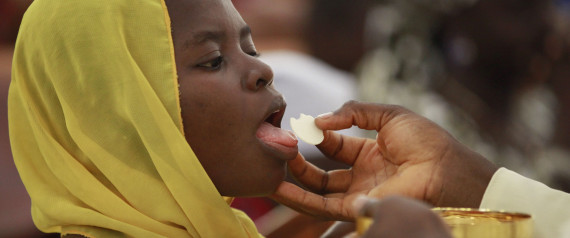
The miracle of God’s physical presence to us at every Mass is the truest testament to Christ’s love for us and His desire for each of us to have a personal relationship with Him. Jesus Christ celebrated the first Mass with His disciples at the Last Supper, the night before He died. He commanded His disciples, “Do this in remembrance of me” (Luke 22:19). The celebration of the Mass then became the main form of worship in the early Church, as a reenactment of the Last Supper, as Christ had commanded. Each and every Mass since commemorates Jesus’ sacrifice on the cross through the Holy Eucharist. Because the Mass “re-presents” (makes present) the sacrifice on Calvary, Catholics all around the world join together to be made present in Christ’s timeless sacrifice for our sins. There is something fascinating about continuing to celebrate the same Mass—instituted by Christ and practiced by the early Church—with the whole community of Catholics around the world…and in heaven.

THE REAL PRESENCE

Why does the Catholic Church believe Christ is really present in the Eucharist?
The Catholic doctrine of the Real Presence is the belief that Jesus Christ is literally, not symbolically, present in the Holy Eucharist—body, blood, soul and divinity. Catholics believe in the Real Presence of Christ in the Eucharist because Jesus tells us this is true in the Bible:

“I am the bread of life. Your fathers ate the manna in the wilderness, and they died. This is the bread which comes down from heaven, that a man may eat of it and not die. I am the living bread which came down from heaven; if any one eats of this bread, he will live for ever; and the bread which I shall give for the life of the world is my flesh." The Jews then disputed among themselves, saying, ‘How can this man give us his flesh to eat?’ So Jesus said to them,

"Truly, truly, I say to you, unless you eat the flesh of the Son of man and drink his blood, you have no life in you; he who eats my flesh and drinks my blood has eternal life, and I will raise him up at the last day. For my flesh is food indeed, and my blood is drink indeed. He who eats my flesh and drinks my blood abides in me, and I in him” - John 6:48-56
Furthermore, the early Church Fathers either imply or directly state that the bread and wine offered in the celebration of the Lord’s Supper is really the body and blood of Jesus Christ. In other words, the doctrine of the Real Presence that Catholics believe today was believed by the earliest Christians 2,000 years ago!

This miracle of God’s physical presence to us at every Mass is the truest testament to Christ’s love for us and His desire for each of us to have a personal relationship with Him.

Showing posts with label Holy Water. Show all posts

Thursday, July 28, 2011

DIPPING YOUR HAND IN HOLY WATER

When you come into the church building , what is the first thing you do? Don't you dip your hand into the holy water and make the sign of the cross? Why do you do that? Well, for three reasons:

a. in repentance for your sins;

b. for protection against the Evil One;

c. to remind you of your baptism.

a. Holy water reminds us to be sorry for our sins. When there is the rite of sprinkling in the liturgy, we always sing the Asperges, which means "you will sprinkle or wash". Asperges me hysoppo et mundabor; lavabis me et super nivem dealbabor. These are words from the great penitential psalm, Ps 50: You will sprinkle me with hyssop and I shall be cleansed: you will wash me, and I shall be made whiter than snow.

b. Holy water is a sacramental which is a protection against the snares of the devil. The old prayer for the blessing of holy water said: "O God, creator of unconquered power, King of invincible empire and victor ever-great: who put down the powers of hostile dominion and conquer the fury of the roaring enemy, who fight powerfully against our wicked foes: trembling we beseech you, O Lord, we implore you and beg you: that you might graciously look upon this creature of water and salt, kindly illumine it, sanctify it with the dew of your loving kindness, so that wherever it is sprinkled, through the invocation of your holy Name, every infestation of the unclean spirit be cast out, and the terror of the poisonous serpent be driven far away. And may the presence of the Holy Spirit deign to be with us always, we who implore your mercy."
c. Holy water reminds us of our baptism: of that great day when we ourselves or our parents or sponsors—renounced Satan, professed faith in Christ, and were baptized into the mystery of the Holy Trinity. At that moment all our sins were forgiven: original and actual, and we became children of God, filii in Filio, heirs of the promise, daring now to call God our Father.
When you dip your hand into the holy water font, remember these things, and like Our Lady, treasure them in your heart.

Monday, June 6, 2011

12 STEPS TO AVOID PURGATORY

1. In every prayer you say, every Mass you hear, every Communion you receive, every good work you perform have the express intention of imploring God to grant you a holy and happy death and no Purgatory. Surely God will hear a prayer said with such confidence and perseverance.

2. Always wish to do God’s will. It is in every sense the best for you. When you do or seek anything that is not God’s will, you are sure to suffer. Say, therefore, fervently each time you recite the Our Father: Thy will be done.
3. Accept all the sufferings, sorrows, pains and disappointments of life, be they great or small, ill health, loss of goods, the death of your dear ones, heat or cold, rain or sunshine as coming from God. Bear them calmly and patiently for love of Him and in penance for your sins. Of course, one may use all his efforts to ward off trouble and pain, but when one cannot avoid it let him bear it patiently. Impatience and revolt make sufferings vastly greater and more difficult to bear.
4. The greatest act in Christ’s life was His Passion. As He had a Passion so each one of us has a Passion. Our Passion consists in the sufferings and labors of every day. Therefore, let us do our work, accept its disappointments and hardships and bear our pains in union with the Passion of Christ. We gain more merit by a little pain than by years of pleasure.

5. Forgive all injuries and offences for in proportion, as we forgive others, God forgives us. Go to confession. This sacrament does more than “just” rid us of our sins; it gives us a tremendous increase in sanctifying grace. It wins for us a higher place in Heaven, with increased union with God. Each time we go to confession, we are preserved from many dangers and misfortunes which might otherwise have befallen us. A devout confession helps us to hear the inspirations of the Holy Spirit, and to hear and follow the advice of our guardian angels.

6. Avoid mortal sins, deliberate venial sins and break off bad habits. Then it will be relatively easy to satisfy God’s justice for sins of frailty. Above all avoid sins against charity and chastity in thought, word and deed for these sins are the reason why many souls are detained in Purgatory for a long time.

7. If afraid of doing too much work, do many little things, acts of kindness and charity, give the alms you can, don’t grumble or complain when things are not as you please, don’t complain of others, never refuse to do a favor for others when possible. These and such acts are a splendid penance.

8. Do all in your power for the Holy Souls in Purgatory. Pray for them constantly, get others to do so, join the Friends of the Poor Souls and ask all those you know to do likewise. The Holy Souls will repay you most generously.

9. There is no more powerful way of obtaining from God a most holy and happy death than by weekly confession, daily Mass and daily communion. Masses may be arranged after or before someone’s death to expedite their time in Purgatory.

10. A daily visit to the Blessed Sacrament – if only for three or four minutes – is an easy way of obtaining the same grace. Kneel in the presence of Jesus with eyes fixed on the Tabernacle or Monstrance, sure that He is looking at you, then repeat little prayers like these: My Jesus, Mercy. My Jesus, have pity on me a sinner. My Jesus, I love you. My Jesus, give me a happy death.

11. Enroll in and wear the Brown Scapular of Our Lady of Mount Carmel. “Whosoever dies clothed in this scapular shall not suffer eternal fire.” This is the Blessed Virgin Mary’s Promise, made July 16, 1251 to St. Simon Stock. The Sabbatine Privilege is Mary’s promise to release from Purgatory soon after death all those who: 1) wear the brown scapular 2) observe chastity according to their state in life and 3) say the Little Office of the Blessed Virgin Mary every day. To be eligible for this scapular promise, one must be enrolled in the Family of Carmel. This is a simple ceremony which takes only a moment and may be done by any Carmelite or duly authorized priest. Mary’s motherhood is not limited to Catholics. It is extended to all men. Many miracles of conversion have been wrought in favor of non-Catholics who have practiced the scapular devotion.

12. Use holy water. Holy water is a sacramental that remits venial sin. Because of the blessing attached to it, Holy Church strongly encourages its use upon her children especially when danger threatens such as fire, storms, sickness and other calamities. Every Catholic home should have a supply of holy water. Keep your soul beautifully pure in God’s sight by making the Sign of the Cross carefully while saying: “By this holy water and by Thy Precious Blood, wash away all my sins and the sins of the Poor Souls in Purgatory, O Lord”.