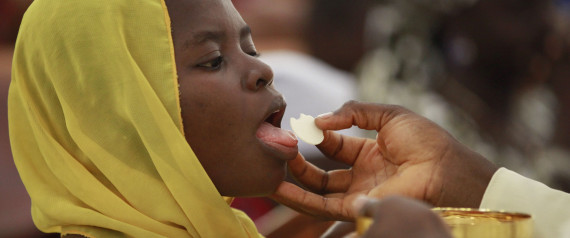
Bread of Life

BREAD OF LIFE
 this is the bread that comes down from heaven so that one may eat it and not die. (john 6: 50)
The miracle of God’s physical presence to us at every Mass is the truest testament to Christ’s love for us and His desire for each of us to have a personal relationship with Him. Jesus Christ celebrated the first Mass with His disciples at the Last Supper, the night before He died. He commanded His disciples, “Do this in remembrance of me” (Luke 22:19). The celebration of the Mass then became the main form of worship in the early Church, as a reenactment of the Last Supper, as Christ had commanded. Each and every Mass since commemorates Jesus’ sacrifice on the cross through the Holy Eucharist. Because the Mass “re-presents” (makes present) the sacrifice on Calvary, Catholics all around the world join together to be made present in Christ’s timeless sacrifice for our sins. There is something fascinating about continuing to celebrate the same Mass—instituted by Christ and practiced by the early Church—with the whole community of Catholics around the world…and in heaven.

THE REAL PRESENCE

Why does the Catholic Church believe Christ is really present in the Eucharist?
The Catholic doctrine of the Real Presence is the belief that Jesus Christ is literally, not symbolically, present in the Holy Eucharist—body, blood, soul and divinity. Catholics believe in the Real Presence of Christ in the Eucharist because Jesus tells us this is true in the Bible:

“I am the bread of life. Your fathers ate the manna in the wilderness, and they died. This is the bread which comes down from heaven, that a man may eat of it and not die. I am the living bread which came down from heaven; if any one eats of this bread, he will live for ever; and the bread which I shall give for the life of the world is my flesh." The Jews then disputed among themselves, saying, ‘How can this man give us his flesh to eat?’ So Jesus said to them,

"Truly, truly, I say to you, unless you eat the flesh of the Son of man and drink his blood, you have no life in you; he who eats my flesh and drinks my blood has eternal life, and I will raise him up at the last day. For my flesh is food indeed, and my blood is drink indeed. He who eats my flesh and drinks my blood abides in me, and I in him” - John 6:48-56
Furthermore, the early Church Fathers either imply or directly state that the bread and wine offered in the celebration of the Lord’s Supper is really the body and blood of Jesus Christ. In other words, the doctrine of the Real Presence that Catholics believe today was believed by the earliest Christians 2,000 years ago!

This miracle of God’s physical presence to us at every Mass is the truest testament to Christ’s love for us and His desire for each of us to have a personal relationship with Him.

Showing posts with label Isaiah. Show all posts

Saturday, June 30, 2012

BLESSED IS HE WHO DOES NOT FALL AWAY....

Many times in our lives, God throws us a curve ball. How are we to respond so that we hit a home run, rather than strike out?

by Lorraine E. Espenhain | Source: Catholic.net


"Blessed is the man who does not fall away on account of Me." [Mt 11:6].

When reading the Holy Scriptures, we often have a tendency to paint the people in the Bible as being larger than life. We see them as men and women who are above human frailties and who walk in spiritual victory every step of the way without stumbling once. Nothing, however, could be further from the truth, and John the Baptist is no exception to this rule.

Cast into prison for his faithfulness to preach the Truth, the whole Truth, and nothing but the Truth, John’s faith in Christ began to waver. He became confused. He stumbled in his faith. Simply put, he didn’t understand what in the world was going on. Things were happening that, in his mind, were not supposed to happen.

While in prison, John heard all that Christ was accomplishing in His ministry. He then sent his disciples to Jesus to ask Him the following question: "Are You the One Who was to come or should we expect someone else?" How could this be? What happened to this great man of faith? When Jesus came from Galilee to the Jordan to be baptized, John knew who He was then. In those days, his faith in Christ was so strong that he looked into the face of our Lord and said, "I need to be baptized by You, and do you come to me?"

Why was John confused? What caused him to stumble? Why was he now being plagued with doubts concerning the Lord Jesus Christ? Since we aren’t omniscient, we can only speculate as to what sorts of thoughts were going through the mind of John the Baptist as he moldered in his prison cell day after day. If Jesus was the Messiah, and John was the forerunner of this Messiah whose coming was foretold by the Old Testament prophets, why did Jesus allow him to be imprisoned? Why wasn’t he coming to his rescue? Why was he just leaving him there to suffer? It could also be that John was guilty (like many in Israel) of entertaining preconceived ideas and notions concerning the Messiah and what He would accomplish in Israel. In John’s mind, the Messiah would do such and such. But here was Jesus, bypassing the throne of Israel for which the Messiah was destined, and teaching, performing miracles, and healing the sick instead!

Jesus knew exactly what was going on in John’s mind, and so He replied to John’s disciples in the following manner:
"Go back and report to John what you hear and see. The blind receive sight, the lame walk, those who have leprosy are cured, the deaf hear, the dead are raised, and the good news is preached to the poor."
This was Jesus’ way of saying to John, "Don’t you remember what Isaiah prophesied concerning the Messiah? Have you forgotten what is written in the scroll, John? The Messiah would take up humanity’s infirmities. He would have an awesome healing ministry. The very miracles that I am doing prove that I am He Who was prophesied to come!"

Before John’s disciples left Jesus to take His message back to John, Jesus added one other point:
"Blessed is the man who does not fall away on account of Me."
What did Jesus mean by these words? Were these words meant for John the Baptist only or were they meant for us as well? I am convinced that Jesus’ words to John were meant for us as well, for we are all human and prone to stumble in our journey of faith. What, then, was Jesus saying to John and to us? Blessed are those who do not stumble or become hindered in their faith when Christ does not act according to the plans and preconceived ideas they've worked out in their own minds concerning how things will go in their lives and how God will move in those lives as well.

In baseball, a curve is a ball thrown by a right-handed pitcher that curves to the pitcher’s left, or one thrown by a left-handed pitcher that curves to the pitcher’s right. The pitcher knows exactly what course the ball is going to take since he is the one who throws it. The one thrown into confusion, however, is the player who is holding the bat. He sees the ball coming straight at him, but suddenly, that ball curves and moves in a different direction than he was expecting.

Many times in our lives, God throws us a curve ball. He allows things to happen in our lives that we weren’t expecting to happen. In our minds, we carefully lay out a blueprint of how we expect God to move in our lives, and when things don’t go according to our plan, like John the Baptist, we stumble in our faith. A man loses his job. A child runs away from home. A loved one suddenly passes away. Some of these curve balls can be frustrating, while others are painful and frightening. How are we to respond when these balls come our way?

First, we must never lose sight of the truth that God is the Pitcher. He is the One who allows those unexpected situations into our lives because He knows the good He intends to bring out of them. He knows exactly what course the ‘ball’ is going to take. He is in complete control.

Second, beware of focusing on your plans. Long-term planning is good, but we get into all sorts of trouble in our faith journey when those plans cause us to lose sight of God’s sovereignty over our lives. Without meaning to, many Christians have a tendency to usurp God’s authority and ownership over their lives when they exhaust and spend themselves in their efforts to carry out their own plans instead of yielding to God and His plans for their lives. Instead, we must learn to live day by day, moment by moment, making Christ the center of that moment. I am convinced that if we are drawing closer to God in our daily lives through prayer, meditation, study of the Scriptures, and obedience to those Scriptures, the Spirit of God will move us in the direction of His will for our lives. When we draw closer to the Lord in our daily lives (through the above-mentioned disciplines), we place ourselves in a position where we are more sensitive to the leading and guiding of His Spirit. But when we move away from those necessary disciplines, the exact opposite happens, and we experience difficulty in discerning God’s voice.

Sometimes, even when we are drawing closer to God in our daily lives, the unexpected still happens. We’re not omniscient. We don’t know what tomorrow holds. Only God knows. During those times, the Lord wants us to trust in Him completely and to lean on the strength that only He can give. When going through a difficult, confusing, or frustrating time, we must live moment by moment, making Christ the center of that moment.

Thirteen years ago, my husband lost his job, and we were forced to relocate to another part of the United States. For the first time in my life, I would be separated from my parents, siblings, relatives, and all things familiar. While coping with this distress, my father was diagnosed with inoperable cancer. Four months after relocating, he passed away. I had to figure out a way to survive that dark time emotionally. All sorts of thoughts would race through my mind in those days. How will I get through the night? The month? The holidays? When I would dwell on getting through the night, the month, or the upcoming holidays, I became overwhelmed and filled with despair. It was too much. If I didn’t rethink my focus, I knew that I would fall apart. I decided then and there that in order to get through that dark period in my life, I would live moment by moment. I didn’t want to focus on next week, next month, or next year. My trial was much easier to handle if I endured it moment by moment. My focus would not be on the pain of that moment, but on making Christ the center of that moment. It worked. Through this ingenious method, the Spirit of Christ got me through the trial and educated me in a thousand different ways while going through it. I became knowledgeable in things I could not have learned otherwise. I became more fruitful. When all was said and done, I marveled at the understanding and wisdom of God, Who knew exactly how to use that painful situation to work out wonderful things in me so that He would be glorified.

God is in control. He knows exactly what is going on in our lives and what will soon take place. It’s His blueprint we must believe in, not our own. When we focus on our own blueprint, schemes, and plans, we inevitably end up stumbling in our journey of faith. This is the inevitable result anytime the Master Architect’s plans conflict with our own. To avoid this stumbling and this hindrance, we would do well to make Christ’s plans the focus of our lives and not our own.

The words which Jesus spoke to John’s disciples were also meant for us. Blessed is he who does not stumble or become hindered in his faith because of that which Christ has allowed to take place in his life. Blessed is he who does not become plagued with doubt because the road he was taking has been closed off by Heaven, forcing him to take a divinely ordained detour. Blessed is he who does not walk away because things are not going according to his own carefully laid out plans.

Brothers and sisters, let us listen carefully to what the Spirit is saying to the Church! Blessed is he who does not fall away on account of Christ!

Monday, January 30, 2012

CHAPTERS AN VERSES IN THE BIBLE


The books of the Bible vary in length from a single page of modern type to dozens of pages. All but the shortest are divided into chapters, generally a page or two in length.

Each is further divided into verses of a few short lines or sentences. Pasuk (plural pesukim) is the Hebrew term for verse.

The Jewish divisions of the Hebrew text differ at various points from those used by Christians. For instance, in Jewish tradition, the ascriptions to many Psalms are regarded as independent verses, making 116 more verses, whereas the established Christian practice is to count and number each Psalm ascription together with the first verse following it. Some chapter divisions also occur in different places, e.g. 1 Chronicles 5:27-41 in Hebrew Bibles is numbered as 1 Chron 6:1-15 in Christian translations.

Chapters
The original manuscripts did not contain the chapter and verse divisions in the numbered form familiar to modern readers. Some portions of the original texts were logically divided into parts following the Hebrew alphabet; for instance, the earliest known copies of the book of Isaiah use Hebrew letters for paragraph divisions. (This was different from the acrostic structure of certain texts following the Hebrew alphabet, such as Psalm 119 and the book of Lamentations.) There are other divisions from various sources which are different from what we use today.

The Old Testament began to be put into sections before the Babylonian Captivity (586 BC) with the five books of Moses being put into a 154-section reading program to be used in a three-year cycle. Later (before 536 BC) the Law was put into 54 sections and 669 sub-divisions for reading.

By the time of the Council of Nicaea in AD 325, the New Testament had been divided into paragraphs, although the divisions were different from the modern Bible.

An important canon of the New Testament was proclaimed by Pope Damasus I in the Roman synod of 374. Pope Damasus also induced Jerome, a priest from Antioch, to undertake his famous translation of the entire Bible, both Old and New Testaments, from Hebrew and Greek into Latin, the official language of the time. This translation is known as the Vulgate. The Church continued to finance the very expensive process of copying and providing copies of the Bible to local churches and communities from that point up to and beyond the invention of the printing press, which greatly reduced the cost of producing copies of the Scriptures.

Churchmen Archbishop Stephen Langton and Cardinal Hugo de Sancto Caro determined different schemas for systematic division of the Bible in the early 13th century. It is the system of Archbishop Langton on which the modern chapter divisions are based.

Verses
It is presently unknown how early the Hebrew verse divisions were incorporated into the books that comprise the Biblical canon. However, it is beyond dispute that for at least a thousand years the Tanakh has contained an extensive system of multiple levels of section, paragraph, and phrasal divisions that were indicated in Masoretic vocalization and cantillation markings. One of the most frequent of these was a special type of punctuation, the sof passuq, symbol for a full stop or sentence break, resembling the colon mark (:) of English and Latin orthography. With the advent of the printing press and the translation of the Bible into English, Old Testament versifications were made that correspond predominantly with the existing Hebrew full stops, with a few isolated exceptions. A product of meticulous labour and unwearying attention, the Old Testament verse divisions stand today in essentially the same places as they have been passed down since antiquity. Most attribute these to Rabbi Isaac Nathan around 1440.

The first person to divide New Testament chapters into verses was Italian Dominican biblical scholar Santi Pagnini (1470–1541), a system that was never widely adopted.[3] Robert Estienne created an alternate numbering in his 1551 edition of the Greek New Testament.[4] The first English New Testament to use the verse divisions was a 1557 translation by William Whittingham (c. 1524-1579). The first Bible in English to use both chapters and verses was the Geneva Bible published shortly afterwards in 1560. These verse divisions soon gained acceptance as a standard way to notate verses, and have since been used in nearly all English Bibles.

Unlike the Hebrew of the Old Testament, the structure of the Greek language makes it highly susceptible to being broken up into divisions that would be syntactically inappropriate and even contrary to the sense of the passage. Inexact apportionment of the Greek into verses therefore could easily have obscured the intent, relation, emphasis and force of the words themselves, and thus elicited the most strenuous objections of theologians. The retention of Robert Estienne's verse divisions essentially without alteration is a tribute not only to the inherent utility of his contribution to Bible study, but also to his excellent knowledge of the scriptures and grasp of the fine points of the ancient Greek language.

Conclusion
Cardinal Hugo de Sancto Caro is often given credit for first dividing the Latin Vulgate into chapters, but it is the arrangement of his contemporary and fellow cardinal Stephen Langton who in 1205 created the chapter divisions which are used today. They were then inserted into Greek manuscripts of the New Testament in the 1400s. Robert Estienne (Robert Stephanus) was the first to number the verses within each chapter, his verse numbers entering printed editions in 1551 (New Testament) and 1571 (Hebrew Bible).

The division of the Bible into chapters and verses has often elicited severe criticism from traditionalists and modern scholars alike. Critics charge that the text is often divided into chapters in an incoherent way, or at inappropriate rhetorical points, and that it encourages citing passages out of context, in effect turning the Bible into a kind of textual quarry for clerical citations. Nevertheless, the chapter divisions and verse numbers have become indispensable as technical references for Bible study. Nevertheless, the chapters and verses division in the bible should never be held as part of divine inspiration, i.e. as part of the Word of God.