
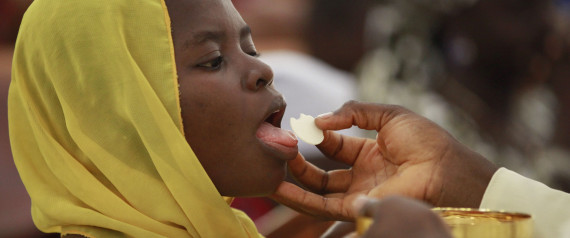


By the consecration the transubstantiation of the bread and wine into the Body and Blood of Christ is brought about. Under the consecrated species of bread and wine Christ himself, living and glorious, is present in a true, real, and substantial manner: his Body and his Blood, with his soul and his divinity (Catechism of the Catholic Church, 1413)
This may sound a little confusing to modern ears because the official Catholic definition has been shaped by a medieval understanding of Aristotelianism. Essentially, the Church teaches that the bread and wine become the body and blood of Christ in substance, while the incidentals (or accidents), the physical characteristics of bread and wine, remain. This means that what you see, feel, and touch will seem to be bread and wine, while in reality, they are actually the body and blood of Christ. St. Cyril of Jerusalem (AD 350) describes this mystery similarly:
Do not, therefore, regard the bread and wine as simply that, for they are, according to the Master's declaration, the Body and Blood of Christ. Even though the senses suggest to you the other, let faith make you firm (Catechetical Lectures 22:6, 9).
Once the bread and wine are properly consecrated, by a validly ordained priest, we receive the certainty of Christ's presence. In other words, the presence of Christ is not dependent on subjective belief on our part, or the moral worthiness of the priest (God does the action, not a man).While Catholics use the term transubstantiation to describe the conversion of the elements into the body and blood, Eastern Orthodox Christians use other terms, including transformation, although they too affirm nothing less than a conversion of the elements into the body and blood of Christ. How this happens is ultimately a mystery, but a mystery based on the promises of Christ, to be experienced by faith.
While the terms describing the change are technical, recently some Catholic leaders have asserted that transubstantiation is the Catholic way of describing the mystical and Real change using limited human language, as opposed to being a term narrowly scientifically and philosophically describing the change. So while transubstantiation still correctly describes the change, the term does not exclude the Eastern definitions (1).
Some might wonder why some of the early Christians called the bread and wine "symbols" or "figures" of Christ's body and blood. Some modern readers have used this in support of their view that the Eucharist is simply a memorial meal, a mental recollection of the death of Jesus. However, context is important when analyzing the early Church Fathers' use of the words "symbol" and "figure."
In the ancient world, in part due to the influence of Platonism, a symbol was seen as substantially and inextricably connected to the reality that it symbolized. The Greek word for symbol literally means "thrown together," signifying the overlapping of a symbol with the universal reality it symbolizes.
Thus, in calling the bread and wine symbols (or in Latin, "figures"), the Church Fathers believed in the true sacramental presence of Christ in the bread and wine, as opposed to a simple psychological recollection. In modern western society, because of the influence of Nominalism and the Enlightenment, we often say, "that's just a symbol" implying a disconnectedness between symbol and reality. Such was not the ancient mindset.
Footnotes
1. See the Anglican/Roman Catholic Joint Declaration on the Eucharist, footnote two, which explains transubstantiation in this manner.

