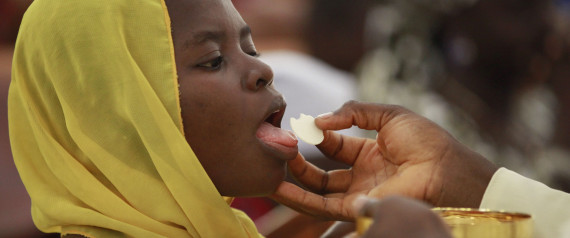
Bread of Life

BREAD OF LIFE
 this is the bread that comes down from heaven so that one may eat it and not die. (john 6: 50)
The miracle of God’s physical presence to us at every Mass is the truest testament to Christ’s love for us and His desire for each of us to have a personal relationship with Him. Jesus Christ celebrated the first Mass with His disciples at the Last Supper, the night before He died. He commanded His disciples, “Do this in remembrance of me” (Luke 22:19). The celebration of the Mass then became the main form of worship in the early Church, as a reenactment of the Last Supper, as Christ had commanded. Each and every Mass since commemorates Jesus’ sacrifice on the cross through the Holy Eucharist. Because the Mass “re-presents” (makes present) the sacrifice on Calvary, Catholics all around the world join together to be made present in Christ’s timeless sacrifice for our sins. There is something fascinating about continuing to celebrate the same Mass—instituted by Christ and practiced by the early Church—with the whole community of Catholics around the world…and in heaven.

THE REAL PRESENCE

Why does the Catholic Church believe Christ is really present in the Eucharist?
The Catholic doctrine of the Real Presence is the belief that Jesus Christ is literally, not symbolically, present in the Holy Eucharist—body, blood, soul and divinity. Catholics believe in the Real Presence of Christ in the Eucharist because Jesus tells us this is true in the Bible:

“I am the bread of life. Your fathers ate the manna in the wilderness, and they died. This is the bread which comes down from heaven, that a man may eat of it and not die. I am the living bread which came down from heaven; if any one eats of this bread, he will live for ever; and the bread which I shall give for the life of the world is my flesh." The Jews then disputed among themselves, saying, ‘How can this man give us his flesh to eat?’ So Jesus said to them,

"Truly, truly, I say to you, unless you eat the flesh of the Son of man and drink his blood, you have no life in you; he who eats my flesh and drinks my blood has eternal life, and I will raise him up at the last day. For my flesh is food indeed, and my blood is drink indeed. He who eats my flesh and drinks my blood abides in me, and I in him” - John 6:48-56
Furthermore, the early Church Fathers either imply or directly state that the bread and wine offered in the celebration of the Lord’s Supper is really the body and blood of Jesus Christ. In other words, the doctrine of the Real Presence that Catholics believe today was believed by the earliest Christians 2,000 years ago!

This miracle of God’s physical presence to us at every Mass is the truest testament to Christ’s love for us and His desire for each of us to have a personal relationship with Him.

Showing posts with label St. Augustine. Show all posts

Wednesday, March 9, 2011

BEING CATHOLIC

We are Catholic and are Proud of it...


"Christian is my name, and Catholic my surname. The one designates me, while the other makes me specific. Thus am I attested and set apart... When we are called Catholics it is by this appellation that our people are kept apart from any heretical name."
Saint Pacian of Barcelona, Letter to Sympronian, 375 A.D..


"Always remain close to the Catholic Church, because it alone can give you true peace, since it alone possesses Jesus in the Blessed Sacrament, the true Prince of Peace."
Blessed Padre Pio...

"It is because Christ is the sole canon of her preaching that the Church adheres so obstinately and so rigidly to His traditional message. It is for this reason that she can endure no modernism, no fraternizing with the spirit of the age."
Karl Adam, The Spirit of Catholicism...

"The Catholic Church understands its opponents, her opponents do not understand the Catholic Church."
Hilaire Belloc, the Great Heresies...

"People can relate to a crucified Christ displayed in Catholic Churches, as each one of us has a cross to carry. None of us can relate to a risen Christ, as none of us has ever risen from the dead."
Fr. Groeschel...

"Apologetic knowledge of the Catholic Church is deeper than the ocean depth and no one will ever reach the bottom."
Anonymous...

"While Protestants study the menu (the Bible), Catholics enjoy the meal."
Dr Scott Hahn...

"Dogmas of the Catholic Church are interconnected. If one is rejected, such as the infallibility of the Pope, then all are rejected."
Fr. Trujillo...

"Here is the shotgun analogy. Fire a Protestant shotgun and a Catholic shotgun at a wall. The pattern will be the opinions of those within, liberal, conservative, etc. With the Catholic, we always know who is at the center, the Pope and the Magisterium. With the Protestant, how can we determine who is in the center?"
Marcus Grodi, ex Protestant minister, now Catholic...

"You blind guides who strain out the gnat but swallow the camel."
Matthew 23:24...

"The Catholic faith does not teach what we used to think and vainly accused it of."
St. Augustine, Confessions, 6, 11, 400 A.D..

"For those who spread lies about the Catholic Church: their ignorance is their lack of knowledge, their stupidity is their wisdom, and their truth is falsehood."
Author Unknown...

"Heretics bring sentence upon themselves since they by their own choice withdraw from the Church, a withdrawal which, since they are aware of it, constitutes damnation."
St. Jerome Commentaries on Titus, 3, 10 386 A.D..

"Where Peter is, there is the Church."
St Ambrose of Milan, On twelve Psalms 381 A.D..

"A Christian man is Catholic while he lives in the body; cut off, he is made a heretic; the Spirit does not follow an amputated member."
Saint Augustine...

"The Catholic Church Always Has What The World Is Lacking."
G.K. Chesterton...

"When the world goes wrong, it proves that the Church is right."
G.K. Chesterton...

"It is contradictory for a Protestant to accept the Bible and reject the authority of the Catholic Church which gave it to him."
Anonymous...

"In attacking the Catholic Church, Protestants sever their own roots."
Author Unknown...

"Protestant Churches have songs and prayer. Catholic Churches have songs, prayer, and sacrifice."
Dr. Scott Hahn...

"No protestant should quote Scripture at all, for he has no means of knowing which books are inspired; Unless of course, he wants to accept the authority of the Catholic Church for that."
Fr. William Most...

"If you read the Bible with Catholic eyes, things will start popping out at you."
Author Unknown...

"Thanks to the Catholic Church, the authority and the integrity of the Bible was kept intact."
Author Unknown...

"Catholic beliefs for 2000 years have been affirmed by independent study."

"The fullness of truth is in the Catholic Church."

"Our Church is the fastest growing Church in the world. We have one billion Catholics in the world today." (1995)
Fr. Luke Zimmer...

Note! Now there are 1,070,000,000 Catholics as of April 2001. World Christian Encyclopedia

You must all follow the lead of the bishop, as Jesus Christ followed that of the Father; follow the presbytery as you would the Apostles; reverence the deacons as you would God's commandment. Let no one do anything touching the Church, apart from the bishop. Let that celebration of the Eucharist be considered valid which is held under the bishop or anyone to whom he has committed it. Where the bishop appears, there let the people be, just as where Jesus Christ is, there is the Catholic Church. It is not permitted without authorization from the bishop either to baptize or to hold an agape; but whatever he approves is also pleasing to God. Thus everything you do will be proof against danger and valid."
Saint Ignatius of Antioch, Letter to the Smyrneans, 107 A.D..

"From what has been said, then, it seems clear to me that the true Church, that which is really ancient, is one; and in it are enrolled those who, in accord with a design, are just... We say, therefore, that in substance, in concept, in origin and in eminence, the ancient and Catholic Church is alone, gathering as it does into the unity of the one faith which results from familiar covenants, - or rather, from the one covenant in different times, by the will of the one GOD and through the one Lord, - those already chosen, those predestined by GOD who knew before the foundation of the world that they would be just."
Saint Clement of Alexandria, Stromateis, 202 A.D..

"It is therefore, the Catholic Church alone which retains true worship. This is the fountain of truth; this, the domicile of faith; this the temple of GOD. Whoever does not enter there or whoever does not go out from here, he is a stranger to the hope of life and salvation... Because, however, all the various groups of heretics are confident that they are the Christians, and think that theirs is the Catholic Church, let it be known: that is the true Church, in which there is confession and penance, and which takes a salubrious care of sins and wounds to which the weak flesh is subject."
Lactantius, The Divine Institutions, 304 A.D..

"Let us note that the very tradition, teaching, and faith of the Catholic Church from the beginning, which the Lord gave, was preached by the Apostles, and was preserved by the Fathers. On this was the Church founded; and if anyone departs from this, he neither is nor any longer ought to be called a Christian."
St. Athanasius, Letter to Serapion of Thmuis, 359 A.D..

"I should not believe the Gospel except as moved by the authority of the Catholic Church."
 Saint Augustine of Hippo, Against the Letter of Mani, 397 A.D..

"This Church is Holy, the One Church, the True Church, the Catholic Church, fighting as she does against all heresies. She can fight, but she cannot be beaten. All heresies are expelled from her, like the useless loppings pruned from a vine. She remains fixed in her root, in her vine, in her love. The gates of hell shall not conquer her."
Saint Augustine of Hippo, Sermon to Catechumens on the Creed, 6, 14, 395 A.D.


©Compiled by Bob Stanley, November 3, 2000
Updated September 3, 2001.

Sunday, August 1, 2010

PREDESTINATION

by Reginald Garrigou-Lagrange, O. P.

PART I

Ch 1: THE TEACHING OF THE CHURCH AND THE THEOLOGICAL SYSTEMS

In the first part we shall direct attention first to the idea of predestination as presented to us in the Scripture. Then we shall inspect the declarations of the Church formulated on the occasion of conflicting heresies. Thus we shall perceive more clearly the point at issue and what precisely constitutes the chief difficulty of the problem.

Then there will be a classification of the various theological opinions to be explained in the course of this work. At the end of this first part we shall remind our readers of the stand taken by St. Augustine and his first disciples, since this exerted a very profound influence on the whole of medieval theology.

CHAPTER I : THE SIGNIFICANCE AND REALITY OF PREDESTINATION ACCORDING TO SCRIPTURE

The Gospel is the good tidings of the redemption of the human race which must be preached to all, for our Savior said: "Going therefore, teach ye all nations: baptizing them in the name of the Father and of the Son and of the Holy Ghost. Teaching them to observe all things whatsoever I have commanded you. And behold I am with you all days even to the consummation of the world." St. Paul says in like manner: "God will have all men to be saved and to come to the knowledge of the truth. For there is one God, and one mediator of God and men, the man Christ Jesus, who gave Himself a redemption for all." (2)

God never commands what is impossible and He makes the fulfilment of His precepts really possible for all, both when they are of obligation and according as they are known. However, there are souls that through their own fault are lost; and souls, at times, that have enjoyed a close intimacy with the Savior, as was the case with the "son of perdition." There are others, the elect, who will infallibly be saved.

Among these are children who die shortly after being baptized, and adults who, by divine grace, not only can observe the commandments, but actually do so and obtain the gift of final perseverance. Jesus in His sacerdotal prayer said to His Father: "Those whom Thou gavest Me have I kept, and none of them is lost, but the son of perdition, that the Scripture may be fulfilled."(3)

Speaking in more general terms, Jesus says again: "My sheep hear My voice. And I know them, and they follow Me. And I give them life everlasting: and they shall not perish for ever. And no man shall pluck them out of My hand. That which My Father hath given Me is greater than all, and no one can snatch them out of the hand of My Father. I and the Father are one."(4)

There are elect chosen by God from all eternity. Jesus spoke of them on several occasions. Once He said: "Many are called, but few are chosen." (5) He announced the destruction of Jerusalem, the distress of those times of trial, and He added: "Unless those days had been shortened, no flesh should be saved; but for the sake of the elect those days shall be shortened." (6)

The precise meaning of these utterances of our Savior are made known to us by what St. Paul tells us about predestination, by which God directs and brings the elect infallibly to eternal life. In one of his epistles we read: "What hast thou that thou hast not received? And if thou hast received, why dost thou glory as if thou hadst not received it?"(7) It is but the comment on the words of the Master, who said: "Without Me you can do nothing." (8)

St. Paul also says: "For it is God who worketh in you, both to will and to accomplish, according to His good will." When writing to the Ephesians, he speaks explicitly about predestination. "Blessed be the God and Father of our Lord Jesus Christ," he says, "who hath blessed us with spiritual blessings in heavenly places in Christ.

As He chose us in Him before the foundation of the world, that we should be holy and unspotted in His sight in charity. Who hath predestinated us unto the adoption of children through Jesus Christ unto Himself, according to the purpose of His will. Unto the praise and glory of His grace, in which He hath graced us in His beloved Son."(
10)

Again, with more clarity of precision, he writes: "We know that to them that love God all things work together unto good: to such as according to His purpose are called to be saints. For whom He foreknew, He also predestinated to be made conformable to the image of His Son, that He might be the firstborn amongst many brethren. And whom He predestinated, them He also called. And whom He called, them He also justified. And whom He justified, them He also glorified." (11)

With St. Augustine, St. Thomas, and St. Bellarmine, we must remark that in this last text the words, "whom He foreknew, He also predestinated," do not refer to the divine foreknowledge of meritorious acts. Nowhere in St. Paul do we find any foundation for this interpretation, and it would contradict several of his texts, especially this one and the ones we are about to cite.

The meaning is: "those whom God foreknew, looking favorably upon them," which is a frequent acceptation of the verb "to know" in the Bible, as in the text: "God has not cast away His people which He foreknew."(12) This exegesis of St. Augustine, St. Thomas, and St. Robert Bellarmine is upheld at the present day by Lagrange, Allo, Zahn, Julicher, and others.(13)

In the Epistle to the Romans (chaps. 9-12), St. Paul in plain terms also sets forth God's sovereign independence in the dispensation of His graces. The Jews, who were the chosen people, are rejected because of their unbelief, and salvation is announced to the Gentiles as a result of Israel's obduracy.

The Apostle prophesies, however, the final conversion and salvation of the Jews, and he formulates the principle of predilection, which is applied to nations and individuals: "What shall we say then? Is there injustice with God? God forbid! For He saith to Moses: I will have mercy on whom I will have mercy. And I will show mercy to whom I will show mercy. So then it is not of him that willeth nor of him that runneth, but of God that showeth mercy." (14)

Hence the Apostle's conclusion: "O the depth of the riches of the wisdom and of the knowledge of God! How incomprehensible are His judgments, and how unsearchable His ways! For who hath known the mind of the Lord? Or who hath been His counsellor? Or who hath first given to Him, and recompense shall be made him? For of Him and by Him and in Him are all things. To Him be glory for ever. Amen." (15)

We shall return later on to a discussion of the literal meaning and scope of these texts, when we present the scriptural background for the teaching of St. Thomas. It suffices for the present to point out with the Thomists and St. Robert Bellarmine (16), what Scripture has to say about the gratuitousness of predestination to eternal life.

Such is the teaching of Scripture, which declares three indisputable things on this point, namely: (1) God has chosen certain persons to constitute the elect.(17) (2) He has caused this election to be efficacious so that they will infallibly get to heaven: "My sheep shall not perish for ever. And no man shall pluck them out of My hand."(18) "Whom He predestinated, them He also called.

And whom He called, them He also justified. And whom He justified, them He also glorified."
(19) (3) God's choice of the elect was entirely gratuitous and previous to any consideration of foreseen merits: "Fear not little flock, for it hath pleased your Father to give you a kingdom."(20) "You have not chosen Me, but I have chosen you; and have appointed you, that you should go and should bring forth fruit and your fruit should remain." (21) "Even so then, at this present time also, there is a remnant saved according to the election of grace.

And if by grace, it is not now by works, otherwise grace is no more grace."
(22) "As He chose us in Him before the foundation of the world, that we should be holy,"(23) and not because we were so, or because He foresaw that we would be so by our own efforts. "For whom He foreknew (in His benevolence), He also predestinated to be made conformable to the image of His Son." (24)

From all these passages of Scripture, St. Augustine formulated this classical definition: "Predestination is the foreknowledge and preparedness on God's part to bestow the favors by which all those are saved who are to be saved."(25) St. Augustine is still more explicit on this point when he writes: "God already knew, when He predestined, what He must do to bring His elect infallibly to eternal life."(26)
Footnotes

1. Matt. 28: 19-20.

2. I Tim. 2: 3-5.

3. John 17: 12.

4. Ibid., 10: 27-30.

5. Matt. 22: 14.

6. Ibid., 24: 22.

7. I Cor. 4: 7.

8. John 15: 5.

9. Phil. 2: 13

10. Eph. 1: 3-7.

11. Rom. 8: 28--30.

12. Rom. 11: 2; d. Matt. 7: 23; Gal. 4: 9; I Cor. 8: 3; 13: 12; II Tim. 2: 19: Ps. 1: 6.

13. Father Lemonnyer, O.P., has explained the deep significance of this standard text of Rom. 8: 28-30, in his article entitled: "Predestination," which was written for the Dict. de th éol. cath. He remarks that God's intention is manifested in this text by two acts: first, there is the act of foreknowing: "those whom He foreknew" (29); then the act of predestinating: "whom He predestinated" (30). But the act of first intention seems to be passed over in silence. As a matter of fact, remarks Father Lemonnyer, it is indicated in the final clause of v. 29: "that He might be the firstborn amongst many brethren:" Here we have this divine intention. . . . This presupposed intention suffices to provide the means for its realization, that is, the discerning and decreeing of the putting of it into effect. This discernment is the foreknowledge, and this decree is the predestination. Both are evidently acts of the practical reason moved by a preconceived intention."

Father Lemonnyer insists upon the gratuitous character of the divine purpose, which is the reason of our salvation and our call. It seems that this gratuitousness must be extended to predestination. Cf. II Tim. 1: 9; Eph. 1: 11; Tit. 3: 5.

14. Rom. 9: 14-17; cf. Lagrange, Epitre aux Romains, 1916, chap. 9, p. 244.

15. Ibid., 11: 33-36.

16. De gratia et lib. arb., Bk. II. chaps. 9-15.

17. Matt. 20: 16; 24: 31; Luke 12: 32; Rom. 8: 33; Eph. 1: 4.

19. John 10: 27 f.; d. Matt. 24: 24; John 6: 39.

20. Rom. 8: 30

21. Luke 12: 32.

22. John 15: 16.

23. Rom. 11: 5.

24. Eph. 1: 4.

25. Rom. 8: 29.

25. De dona perseverantiae, chap. 14.

26. De praedestinatione sanctorum, chap. 10