Bread of Life

BREAD OF LIFE
 this is the bread that comes down from heaven so that one may eat it and not die. (john 6: 50)
The miracle of God’s physical presence to us at every Mass is the truest testament to Christ’s love for us and His desire for each of us to have a personal relationship with Him. Jesus Christ celebrated the first Mass with His disciples at the Last Supper, the night before He died. He commanded His disciples, “Do this in remembrance of me” (Luke 22:19). The celebration of the Mass then became the main form of worship in the early Church, as a reenactment of the Last Supper, as Christ had commanded. Each and every Mass since commemorates Jesus’ sacrifice on the cross through the Holy Eucharist. Because the Mass “re-presents” (makes present) the sacrifice on Calvary, Catholics all around the world join together to be made present in Christ’s timeless sacrifice for our sins. There is something fascinating about continuing to celebrate the same Mass—instituted by Christ and practiced by the early Church—with the whole community of Catholics around the world…and in heaven.

THE REAL PRESENCE

Why does the Catholic Church believe Christ is really present in the Eucharist?
The Catholic doctrine of the Real Presence is the belief that Jesus Christ is literally, not symbolically, present in the Holy Eucharist—body, blood, soul and divinity. Catholics believe in the Real Presence of Christ in the Eucharist because Jesus tells us this is true in the Bible:

“I am the bread of life. Your fathers ate the manna in the wilderness, and they died. This is the bread which comes down from heaven, that a man may eat of it and not die. I am the living bread which came down from heaven; if any one eats of this bread, he will live for ever; and the bread which I shall give for the life of the world is my flesh." The Jews then disputed among themselves, saying, ‘How can this man give us his flesh to eat?’ So Jesus said to them,

"Truly, truly, I say to you, unless you eat the flesh of the Son of man and drink his blood, you have no life in you; he who eats my flesh and drinks my blood has eternal life, and I will raise him up at the last day. For my flesh is food indeed, and my blood is drink indeed. He who eats my flesh and drinks my blood abides in me, and I in him” - John 6:48-56
Furthermore, the early Church Fathers either imply or directly state that the bread and wine offered in the celebration of the Lord’s Supper is really the body and blood of Jesus Christ. In other words, the doctrine of the Real Presence that Catholics believe today was believed by the earliest Christians 2,000 years ago!

This miracle of God’s physical presence to us at every Mass is the truest testament to Christ’s love for us and His desire for each of us to have a personal relationship with Him.

Showing posts with label Last Supper. Show all posts

Saturday, June 18, 2016

JESUS, THE BREAD OF LIFE

White bread, rye bread, wheat bread, pita bread, zucchini bread, and pumpernickel! Perhaps no food comes in as many varieties as bread, known as the staff of life. Because bread is so basic to our life, God was wise to nourish us with divine life in the form of bread, the Eucharist.

Jesus foretold this marvel when he claimed, “I am the bread of life….I am the living bread that came down from heaven; whoever eats this bread will live forever; and the bread that I will give is my flesh for the life of the world” (John 6:48, 51). This was not just a figure of speech.

Jesus meant the words literally. At the Last Supper the night before he died, he held bread in his hands and said to his friends, “This is my body that is for you. Do this in remembrance of me” (1 Corinthians 11:24).

Ever since then Christians have been celebrating the breaking of the bread. We come together to share a meal and be fed with the bread and wine that is Jesus. The Eucharist is a gift of Jesus' love through which we remember his death and resurrection and share in them.

When Jesus called himself the bread of life, his listeners no doubt thought of Moses. Through Moses God sent down manna, bread from heaven that fed the chosen people for 40 years before they reached the promised land. Jesus explained, “Your ancestors ate the manna in the desert, but they died; this is the bread that comes down from heaven so that one may eat it and not die” (John 6:49-51).

God prepared us for the mystery of the Eucharist in several ways. Jesus was born in Bethlehem, a town whose name means “House of Bread.” His mother laid him in a manger, a feeding trough, a hint that someday he would be bread for the world.

All four Gospels tell the story of the miraculous feeding of crowds, which foreshadows what happens at Mass. Jesus fed thousands of people by having the disciples distribute five barley loaves and two fish. After everyone had enough to eat, there were still 12 baskets of leftovers (and in some accounts seven).

Even the time Jesus gave us the Eucharist was a clue to its meaning—the time of Passover. At this feast the Jewish people celebrate their salvation from death in Egypt by a meal that includes unleavened bread and wine.

When we partake of the Eucharist, Jesus feeds us with his body and blood. We enter into communion with him and with one another. Unlike other food, which becomes part of us, Jesus in the sacred bread and wine makes us more like him. Therefore we, too, are to be bread for the world.

The living bread sustains us and prepares us for that day when we will come to the heavenly banquet. It is a pledge of future glory. It is the means by which Christ fulfills his promise, “I came so that they might have life and have it more abundantly” (John 10:10).

† Give us this day our daily bread! †

Tuesday, August 30, 2011

MAY LOVE TRIUMPH!


The Reign of the Eucharistic Heart: The Triumph of Love
Mother Adela, SCTJM

Foundress
For private use only - ©

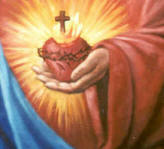
The Eucharist is a Gift of Love of the Sacred Heart

The Eucharist is the outstanding gift of love of the Sacred Heart. We can not understand the Eucharist unless we understand the love of the Heart of Jesus. In the Gospel of St. John chapter 13, we read: "Having loved his own who were in the world, he loved them to the extreme" (Jn 13:1). To the extreme means not sparing anything to manifest its love.

Jesus said to St. Margaret Mary: “Behold, this heart which has loved men so much that it has spared nothing even to exhausting and consuming itself in order to testify to them its love."

The Sacred Heart of Jesus has loved us to the extreme of giving himself totally and freely for our salvation. He has spared nothing up to the point of giving his body, his blood and his heart on the Cross, and he continues to give them to us in the Eucharist. The Eucharist is a gift of his self oblation and of his sacrificial love for men.

In the institution of the Eucharist in the Last Supper, Jesus said to the apostles and to us until the end of time: “This is my body, this is my blood of the new covenant given up for you” (Mt 26). The Eucharist is a gift of the love and generosity of his Sacred Heart. He not only gave up his life, but he gave it up freely because the sign of authentic love is that the sacrifice is offered freely. “I lay down my life, no one takes it from me, but I lay it down freely” (John 10,18). And not only freely but intensely, to the extreme. As Jesus said to St. Margaret: “my divine heart is so inflamed with love for men that being unable any longer to contain within itself the flames of its burning charity, it must spread them abroad and manifest itself to them in order to enrich them with the precious treasures of my Heart”.

When we contemplate the Eucharist, we contemplate the Heart that has been pierced out of love, the Heart that constantly renews his immolation, his self oblation, his sacrifice. We contemplate, therefore, this ever oblative love of the Heart of Christ. We contemplate the Heart of Christ that has loved us to the extreme of the Cross and of the Eucharist.

Is not the Eucharist the constant reminder of the generosity and self oblation of the Heart of Christ? Self oblation and generosity are the fruit of his love to the extreme. The self oblation of His Heart reveals to us that love is the victory over evil. He conquers the hardness of the human heart, not by force, but by offering the testimony of the power of his love. Is not the Eucharist the living sign of this sacrificial love? He gives himself to us, to us who have rejected him and despised him.

He taught us to live the way of love, the only way that conquers evil:
• He gave us the testament of love and instituted the sacrament of love the night he was going to be betrayed, denied and imprisoned by us.
• He took upon himself our sins, bearing our infirmities; by his wounds we were healed. His sufferings brought us eternal happiness.
• He gives us his blood to quench our thirst even when we go after the puddles of sterile waters "My blood is drink of eternal life” (John 6:55).
• He gives us his body to fill our hunger even when we want to satisfy ourselves with temporal food. "I am the bread of life whoever come to me shall not hunger” (John 6:35).
• He stays with us until the end of times, to accompany us, even when we abandon him. “Our loving Redeemer, on the last night of his life, knowing that the time had arrived on which he should die for the love of men, had not the heart to leave us alone in this valley of tears; but in order that he might not be separated from us even by death, he would leave us himself on the Sacrament of the Altar understanding that He could give us nothing further to prove to us his love." St. Alphonsos de Liguori.
• Out of rejection we pierced His Heart, and from it, gushed forth blood and water, the great sacraments of baptism and the Eucharist.
• From his opened side, he gave life to the Church and left the Eucharist to be the living heart of the Church, to sustain her, nurture her and strengthen her in her mission of being a sign of love in the world. The Blessed Sacrament is the living heart of each of our churches. (Pope Paul VI)
• To actualize the power of his redemption to all generations he commanded the apostles and their successors to perpetuate the Sacrifice of the Cross, making it possible for all men in every generation to be at the foot of the Cross receiving the power of salvation.
• He remains in all the tabernacles, like he said to St. Therese of Lesieux, as “ the prisoner of love." A prisoner so we can receive his freedom. He is there, he has chosen to stay vulnerable even to men, simply to be able to offer his love to the human heart. To St. Faustina he said, from the Blessed Sacrament: “Love has brought me here and love keeps me here.”
That is love!! The Eucharistic Heart is the model of love described by St. Paul in 1 Corinthians 13: “Love is patient, love is kind, it is not jealous, not rude, it does not seek its own interest, it is not quick tempered, it does not rejoice in wrong but rejoices in the truth. It bears all things, hopes all things, endures all things, love never fails.”

Wednesday, July 20, 2011

TRANSUBSTANTIATION

The Roman Catholic Church through history approached her faith life with the clarification of language. That is, she translated the essentials of revealed faith into the vocabulary of living language.

To the revealed Word that there is "Father, Son and Holy Spirit" the Church labeled the belief "Trinity."
To the revealed Word that the "Son of God became man" the Church labeled the belief "Incarnation."
To the revealed Word that the "blood of Christ spilled on Calvary saved us" the Church labeled the belief "Redemption."
To the revealed Word that "my flesh is true food, my blood is true drink" the Church labeled the belief "Transubstantiation."
Transubstantiation reflects Roman Catholic faith in the literalness of the words of the Bible.

Jesus (omnipotent God) said: "This is my body; this is my blood." And again Jesus said: "I am the bread of life;" "My flesh is true food; my blood is true drink;" "He who eats my flesh and drinks my blood ...;" etc.

Roman Catholics take Jesus at His word: the bread is his body; the wine is his blood.

From the Apostles at the Last Supper until today, the bread and wine of Eucharist looks and feels and tastes like bread and wine in the eating and drinking.

Similar to all of God's Word, faith is essential. Faith in what? In the words of Jesus even though the bread does not look, feel, taste like flesh; even though the wine does not look, feel, taste like blood.

Medieval philosophers and theologians sought simply to label this simple biblical faith: Jesus said that bread is his body and wine is his blood even though it did not appear to change into visible flesh and blood.
Transubstantiation means the substance part of the bread and wine elements changes; but the accidental parts--sight, taste, smell, touch--do not. Catholics believe that since Jesus said it and He is God, he can do it. They believe! "Transubstantiation" merely labels it.
In everyday life, it is not at all uncommon to believe in things man cannot perceive by the senses: wind, electricity, love, peace, etc. All the more when Jesus says it.

Wednesday, April 20, 2011

CHRIST'S LAST SUPPER - "TAKE AND EAT...."

by Kathryn Marcellino, OCDS

The Mystical Supper, Icon by Simon Ushakov (1685).

On Holy Thursday, we celebrate Jesus' last supper before his death. On that night, "He said to them, 'I have eagerly desired to eat this Passover with you before I suffer.'" (Luke 22:15) "And he took bread, and when he had given thanks he broke it and gave it to them, saying, 'This is my body which is given for you. Do this in remembrance of me.' And likewise the cup after supper, saying, 'This cup which is poured out for you is the new covenant in my blood.' " (Luke 22:19-20)

Throughout the centuries the Church has fulfilled Jesus request at the Last Supper to "do this in remembrance of me" through the sacrifice of the Mass and the sacrament of Holy Communion.

What does Jesus actually mean by his words at the Last Supper? Not every Christian or even every Catholic agrees on their meaning; however, the Catholic Church officially teaches that the Gospels mean just what they say and are literally true.

"It is common knowledge that among all the Scriptures, even those of the New Testament, the Gospels have a special preeminence, and rightly so, for they are the principal witness for the life and teaching of the incarnate Word, our savior. The Church has always and everywhere held and continues to hold that the four Gospels are of apostolic origin. For what the Apostles preached in fulfillment of the commission of Christ, afterwards they themselves and apostolic men, under the inspiration of the divine Spirit, handed on to us in writing: the foundation of faith, namely, the fourfold Gospel, according to Matthew, Mark, Luke and John... Holy Mother Church has firmly and with absolute constancy held, and continues to hold, that the four Gospels just named, whose historical character the Church unhesitatingly asserts, faithfully hand on what Jesus Christ, while living among men, really did and taught for their eternal salvation until the day He was taken up into heaven (see Acts 1:1). Indeed, after the Ascension of the Lord the Apostles handed on to their hearers what He had said and done." (see Dei Verbum Chapter 5, 18 and 19)

The Catholic Church teaches that Holy Communion is not merely symbolic and that in this sacrament Jesus gives us his very self to nourish us spiritually and to help us become more united to himself so that we might have "life". Jesus said, "I am the way, the truth and the life." The Church teaches that when we receive Holy Communion we are receiving Christ's actual body, blood, soul and divinity.

"The mode of Christ's presence under the Eucharistic species is unique. It raises the Eucharist above all the sacraments as 'the perfection of the spiritual life and the end to which all the sacraments tend.' In the most blessed sacrament of the Eucharist "the body and blood, together with the soul and divinity, of our Lord Jesus Christ and, therefore, the whole Christ is truly, really, and substantially contained." It is by the conversion of the bread and wine into Christ's body and blood that Christ becomes present in this sacrament. The Church Fathers strongly affirmed the faith of the Church in the efficacy of the Word of Christ and of the action of the Holy Spirit to bring about this conversion." (CCC1374-1375)

That is why the Church teaches that "the Eucharist is 'the source and summit of the Christian life.' 'The other sacraments, and indeed all ecclesiastical ministries and works of the apostolate, are bound up with the Eucharist and are oriented toward it. For in the blessed Eucharist is contained the whole spiritual good of the Church, namely Christ himself...' " (CCC 1324)

Despite these very clear official teachings of the Catholic faith, there was a Gallup poll taken in 1992 of Catholics regarding Holy Communion of 519 U.S. Catholics and in this poll only 30% of those asked said they believed that in Holy Communion we actually do receive the Body, Blood, Soul and Divinity of Jesus Christ under the appearance of bread and wine (also known as the Real Presence). For this reason I would like to go into some logical reasons that we can accept this teaching (even though if we really understand our Catholic faith we come to understand that the Church has infallible teachings, and this is one of them, so really each Church teaching does not need to be proven, rather as the Catechism states that having the Catholic faith means that: "We believe all 'that which is contained in the word of God, written or handed down, and which the Church proposes for belief as divinely revealed' " CCC 182.)

So what other evidence besides Church teaching do we have that Jesus actually meant what he said literally at the Last Supper? Below are some reasons and even some miracles supporting this teaching.

Many or most Christians believe the Bible is the inerrant word of God, but the question remains, what is the correct interpretation? Why do many denominations believe something different if the Bible is easy to understand? The answer is that we have other information (including Sacred Tradition) about Jesus that is not contained in the Bible and that sheds light on what he meant.

To me it is reasonable to believe that Jesus would make sure through his personal instructions to his apostles and also through the Holy Spirit at Pentecost that Peter and the apostles would understand what He taught and meant so they could teach these truths to the world. So it is logical to believe that the apostles and those whom they personally instructed would understand what Jesus' words at the Last Supper meant as well as his other teachings... and if they did not understand right away, Jesus would make sure they understood through the gift of the Holy Spirit at Pentecost and before he commissioned them to preach the Gospel to the whole world.

So what did the apostles and early Christians believe about Holy Communion? We have both the Bible and early church writings to see what they meant. Below are some examples.

In the Bible we see what St. Paul's said in Corinthians:

"The cup of blessing which we bless, is it not a participation in the blood of Christ? The bread which we break, is it not a participation in the body of Christ? Because there is one bread, we who are many are one body, for we all partake of the one bread." (1 Cor. 10:16-17)

"For I received from the Lord what I also delivered to you, that the Lord Jesus on the night when he was betrayed took bread, and when he had given thanks, he broke it, and said, 'This is my body which is for you. Do this in remembrance of me.' In the same way also the cup, after supper, saying, 'This cup is the new covenant in my blood. Do this, as often as you drink it, in remembrance of me.' For as often as you eat this bread and drink the cup, you proclaim the Lord's death until he comes. Whoever, therefore, eats the bread or drinks the cup of the Lord in an unworthy manner will be guilty of profaning the body and blood of the Lord. Let a man examine himself, and so eat of the bread and drink of the cup. For any one who eats and drinks without discerning the body eats and drinks judgment upon himself." (1 Cor. 11:23-29)

Also in the Gospel of John, Chapter 6, we see that Jesus has already introduced the idea of eating his body and blood before the Last Supper:

Jesus said in John 6:48-65: " 'I am the bread of life. Your ancestors ate the manna in the desert, but they died; this is the bread that comes down from heaven so that one may eat it and not die. I am the living bread that came down from heaven; whoever eats this bread will live forever; and the bread that I will give is my flesh for the life of the world.' The Jews quarreled among themselves, saying, 'How can this man give us (his) flesh to eat?' Jesus said to them, 'Amen, amen, I say to you, unless you eat the flesh of the Son of Man and drink his blood, you do not have life within you. Whoever eats my flesh and drinks my blood has eternal life, and I will raise him on the last day.

For my flesh is true food, and my blood is true drink. Whoever eats my flesh and drinks my blood remains in me and I in him. Just as the living Father sent me and I have life because of the Father, so also the one who feeds on me will have life because of me. This is the bread that came down from heaven. Unlike your ancestors who ate and still died, whoever eats this bread will live forever.' These things he said while teaching in the synagogue in Capernaum. Then many of his disciples who were listening said, 'This saying is hard; who can accept it?' Since Jesus knew that his disciples were murmuring about this, he said to them, 'Does this shock you?

What if you were to see the Son of Man ascending to where he was before? It is the spirit that gives life, while the flesh is of no avail. The words I have spoken to you are spirit and life. But there are some of you who do not believe.' Jesus knew from the beginning the ones who would not believe and the one who would betray him. And he said, 'For this reason I have told you that no one can come to me unless it is granted him by my Father.'"

If Jesus really meant what he said literally we would expect the early Christians to also believe this way (having been taught by the apostles and their successors) and we find historically that they did take Jesus' words about Holy Commuion literally and not just symbolically as some do today. Below is a short sample of what some of the Early Church Fathers of the first few centuries said about the Eucharist.

Justin Martyr: "We call this food Eucharist, and no one else is permitted to partake of it, except one who believes our teaching to be true and who has been washed in the washing which is for the remission of sins and for regeneration [i.e., has received baptism] and is thereby living as Christ enjoined. For not as common bread nor common drink do we receive these; but since Jesus Christ our Savior was made incarnate by the word of God and had both flesh and blood for our salvation, so too, as we have been taught, the food which has been made into the Eucharist by the Eucharistic prayer set down by him, and by the change of which our blood and flesh is nurtured, is both the flesh and the blood of that incarnated Jesus" (First Apology 66 [A.D. 151]).

Irenaeus: "If the Lord were from other than the Father, how could he rightly take bread, which is of the same creation as our own, and confess it to be his body and affirm that the mixture in the cup is his blood?" (Against Heresies 4:33–32 [A.D. 189]).

St. Augustine: "What you see is the bread and the chalice; that is what your own eyes report to you. But what your faith obliges you to accept is that the bread is the body of Christ and the chalice is the blood of Christ. This has been said very briefly, which may perhaps be sufficient for faith; yet faith does not desire instruction" (Sermons 411).

"He has declared the cup, a part of creation, to be his own blood, from which he causes our blood to flow; and the bread, a part of creation, he has established as his own body, from which he gives increase unto our bodies. When, therefore, the mixed cup [wine and water] and the baked bread receives the Word of God and becomes the Eucharist, the body of Christ, and from these the substance of our flesh is increased and supported, how can they say that the flesh is not capable of receiving the gift of God, which is eternal life—flesh which is nourished by the body and blood of the Lord, and is in fact a member of him?" (ibid. 5:2).

Clement of Alexandria: "’Eat my flesh,’ [Jesus] says, ‘and drink my blood.’ The Lord supplies us with these intimate nutrients, he delivers over his flesh and pours out his blood, and nothing is lacking for the growth of his children" (The Instructor of Children 1:6:43:3 [A.D. 191]).

We also have the witness of some early Christian martyrs who gave up their lives because of their believe in this teaching.

Besides the official teaching of the Church, the Bible and Early Church Fathers, there have been various miracles throughout the centuries to point to the "real presence" of Jesus in the Eucharist. Some of these miracles have been scientifically validated in modern times like the one at Lanciano where in the presence of an unbelieving priest and those present the host actually took on the appearance of real human flesh. To find out more click here. To read about other Eucharistic miracles click here.

Also the Saints through whom God has worked many miracles had a great devotion to Jesus in the Eucharist. Here are a few examples:

St. John Vianney: "If we really understood the Mass, we would die of joy." "There is nothing so great as the Eucharist. If God had something more precious, He would have given it to us."

St. Jerome: "Without doubt, the Lord grants all favors which are asked of Him in Mass, provided they be fitting for us; and, which is a matter of great wonder, ofttimes He also grants that also which is not demanded of Him, if we, on our part, put no obstacle in the way."

St. Leonard of Port Maurice: "Be now confounded for very wonder, reflecting that the proposition just laid down is indeed most true; a soul assisting with adequate devotion at holy Mass renders more honor to God than that which all the Angels and all the Saints put together render with all their adorations."

The above examples are just a few quotes from Church teachings, Early Church Fathers, teachings of the Saints, and also miracles associated with the Eucharist. So what is one to make of all this? Perhaps some Christians who believe in the Bible and take it literally don't take these words of Christ literally, but upon in-depth study of the sources mentioned, if one takes the time to study them it seems most reasonable to take Jesus' words literally remembering that God can do all things. It is just a matter as to what Jesus really meant by his teachings, not whether this is possible or even probable, because the Bible says that "with God all things are possible." (Matt. 19:26)

Our Catholic faith teaches us when we go to Mass that Jesus is not only there in spirit but is actually physically present in Holy Communion and that we can be united to Jesus in this special way by receiving him. After all it is Jesus himself who said in the Gospel of John, Chapter 6, that we must eat his body if we want life within us. The disciples didn't understand what Jesus could mean when he first said this and some of them left, but we find out at his last supper what he meant. Jesus was referring to Holy Communion and repeated this teaching at the Last Supper when he said, "Take and eat; this is my body." (Matt 26:26) and said to do this in remembrance of him which we do at each Mass.

We can be united to Jesus in a very special way here on earth through the reception of Holy Communion. This is what Jesus desired. I can see no other way we can be closer to Jesus on this earth both physically and spiritually than receiving him with devotion and love in Holy Communion.

There is so much to say about Holy Communion that a short article like this cannot cover. I would invite everyone to read what the Catechism of the Catholic Church says about the Sacrament of the Eucharist. It is online here at: http://www.scborromeo.org/ccc/p2s2c1a3.htm. At my website at catholicspiritualdirection.org there is a page with links to Church documents and writings of the saints here. There are also some very good talks and books on the Mass and Eucharist such as Scott Hahn's The Lamb's Supper. If we want to really know our faith we need to take time to study.

If you are not sure if Jesus really meant what he said at the Last Supper to be taken literally and/or about any other Catholic teachings, I invite you to study the actual teachings of the Church (i.e. the Catechism, papal encyclicals, teachings of the saints, writings of the Early Church Fathers, and solidly Catholic books on the subject), and also to ask Jesus in prayer with an open heart to show you his desire and the truth regarding this and other teachings. For those of us who do believe, let us have a greater devotion and reverence to Jesus in this Sacrament and faithfully attend Mass at least each Sunday.

Saturday, April 2, 2011

I BELIEVE

I believe that on the night before His Death on the Cross Our Lord Jesus Christ instituted the Holy Eucharist, when at the Last Supper He changed bread and wine into His Body and Blood, which He offered to His Father for the salvation of all mankind and gave to His disciples to be their Food and Drink.

I believe that Jesus at the Last Supper began the Perfect Sacrifice of His Body and Blood, which He completed for our salvation on the Cross, and now daily renews on our altars in the Holy Sacrifice of the Mass, of which He is both the Victim and the Principal Offerer.

I believe that Christ having died upon the Cross dies now no more, but that His Holy Death is mystically perpetuated in the Holy Sacrifice of the Mass in a most wondrous manner, and is continually offered to God for the salvation of all mankind.

I believe that the Holy Eucharist is both a Sacrifice and a Sacrament, and that as a Sacrament, which we lovingly call the Blessed Sacrament of the Altar, the Holy Eucharist is truly the Bread of Life and the Cup of Eternal Salvation, and that in this Holy Sacrament there is truly contained wholly and substantially the Body and Blood of Christ, together with His Soul and Divinity co-joined.

I believe that Jesus continues to remain, veiled beneath the appearance of the Sacred Forms of Bread and Wine after the Holy Sacrifice is over, for our Spiritual Food and Drink, for our need and that of the sick to whom He is brought.

I believe that in receiving Christ in Holy Communion, He is not changed into us, but we are changed into Him.

I believe that at the Last Supper Christ Our Lord gave the Apostles the exalted power to be His Ministers in offering the Holy Sacrifice of the Mass, and that through them the same power is transmitted perpetually to the bishops and priests of the Church.

I believe that in the Holy Liturgy of the Mass, just as at the Last Supper, Christ effects a complete change in the bread and wine, so that although the forms of bread and wine remain, the whole substance of these elements is changed into His Body and Blood.

I believe that the Holy Eucharist has been given to us by Christ to be the bond of love between God and Man, and Man with his Fellowman.

I believe, 0 Lord, Strengthen My Faith.

Monday, November 1, 2010

CHRIST IN THE EUCHARIST

Protestant attacks on the Catholic Church often focus on the Eucharist. This demonstrates that opponents of the Church—mainly Evangelicals and Fundamentalists — recognize one of Catholicism’s core doctrines. What’s more, the attacks show that Fundamentalists are not always literalists. This is seen in their interpretation of the key biblical passage, chapter six of John’s Gospel, in which Christ speaks about the sacrament that will be instituted at the Last Supper. This tract examines the last half of that chapter.

John 6:30 begins a colloquy that took place in the synagogue at Capernaum. The Jews asked Jesus what sign he could perform so that they might believe in him. As a challenge, they noted that "our ancestors ate manna in the desert." Could Jesus top that? He told them the real bread from heaven comes from the Father. "Give us this bread always," they said. Jesus replied, "I am the bread of life; whoever comes to me will never hunger, and whoever believes in me will never thirst." At this point the Jews understood him to be speaking metaphorically.

Again and Again

Jesus first repeated what he said, then summarized: "‘I am the living bread which came down from heaven; if any one eats of this bread, he will live for ever; and the bread which I shall give for the life of the world is my flesh.’ The Jews then disputed among themselves, saying, ‘How can this man give us his flesh to eat?’" (John 6:51–52).
His listeners were stupefied because now they understood Jesus literally — and correctly. He again repeated his words, but with even greater emphasis, and introduced the statement about drinking his blood: "Truly, truly, I say to you, unless you eat the flesh of the Son of man and drink his blood, you have no life in you; he who eats my flesh and drinks my blood has eternal life, and I will raise him up at the last day. For my flesh is food indeed, and my blood is drink indeed. He who eats my flesh and drinks my blood abides in me, and I in him" (John 6:53–56).
No Corrections

Notice that Jesus made no attempt to soften what he said, no attempt to correct "misunderstandings," for there were none. Our Lord’s listeners understood him perfectly well. They no longer thought he was speaking metaphorically. If they had, if they mistook what he said, why no correction?

On other occasions when there was confusion, Christ explained just what he meant (cf. Matthew 16:5–12). Here, where any misunderstanding would be fatal, there was no effort by Jesus to correct. Instead, he repeated himself for greater emphasis.

In John 6:60 we read: "Many of his disciples, when they heard it, said, ‘This is a hard saying; who can listen to it?’" These were his disciples, people used to his remarkable ways. He warned them not to think carnally, but spiritually: "It is the Spirit that gives life, the flesh is of no avail; the words that I have spoken to you are spirit and life" (John 6:63; cf. 1 Corinthians 2:12–14).

But he knew some did not believe. (It is here, in the rejection of the Eucharist, that Judas fell away; look at John 6:64.) "After this, many of his disciples drew back and no longer went about with him" (John 6:66).

This is the only record we have of any of Christ’s followers forsaking him for purely doctrinal reasons. If it had all been a misunderstanding, if they erred in taking a metaphor in a literal sense, why didn’t he call them back and straighten things out? Both the Jews, who were suspicious of him, and his disciples, who had accepted everything up to this point, would have remained with him had he said he was speaking only symbolically.

But he did not correct these protesters. Twelve times he said he was the bread that came down from heaven; four times he said they would have "to eat my flesh and drink my blood." John 6 was an extended promise of what would be instituted at the Last Supper—and it was a promise that could not be more explicit. Or so it would seem to a Catholic. But what do Fundamentalists say?

Merely Figurative?

They say that in John 6 Jesus was not talking about physical food and drink, but about spiritual food and drink. They quote John 6:35: "Jesus said to them, ‘I am the bread of life; he who comes to me shall not hunger, and he who believes in me shall never thirst.’" They claim that coming to him is bread, having faith in him is drink. Thus, eating his flesh and blood merely means believing in Christ.

But there is a problem with that interpretation. As Fr. John A. O’Brien explains, "The phrase ‘to eat the flesh and drink the blood,’ when used figuratively among the Jews, as among the Arabs of today, meant to inflict upon a person some serious injury, especially by calumny or by false accusation. To interpret the phrase figuratively then would be to make our Lord promise life everlasting to the culprit for slandering and hating him, which would reduce the whole passage to utter nonsense" (O’Brien, The Faith of Millions, 215). For an example of this use, see Micah 3:3.

Fundamentalist writers who comment on John 6 also assert that one can show Christ was speaking only metaphorically by comparing verses like John 10:9 ("I am the door") and John 15:1 ("I am the true vine"). The problem is that there is not a connection to John 6:35, "I am the bread of life." "I am the door" and "I am the vine" make sense as metaphors because Christ is like a door—we go to heaven through him—and he is also like a vine—we get our spiritual sap through him. But Christ takes John 6:35 far beyond symbolism by saying, "For my flesh is food indeed, and my blood is drink indeed" (John 6:55).

He continues: "As the living Father sent me, and I live because of the Father, so he who eats me will live because of me" (John 6:57). The Greek word used for "eats" (trogon) is very blunt and has the sense of "chewing" or "gnawing." This is not the language of metaphor.

Their Main Argument

For Fundamentalist writers, the scriptural argument is capped by an appeal to John 6:63: "It is the spirit that gives life, the flesh is of no avail; the words that I have spoken to you are spirit and life." They say this means that eating real flesh is a waste. But does this make sense?

Are we to understand that Christ had just commanded his disciples to eat his flesh, then said their doing so would be pointless? Is that what "the flesh is of no avail" means? "Eat my flesh, but you’ll find it’s a waste of time"—is that what he was saying? Hardly.

The fact is that Christ’s flesh avails much! If it were of no avail, then the Son of God incarnated for no reason, he died for no reason, and he rose from the dead for no reason. Christ’s flesh profits us more than anyone else’s in the world. If it profits us nothing, so that the incarnation, death, and resurrection of Christ are of no avail, then "your faith is futile and you are still in your sins. Then those also who have fallen asleep in Christ have perished" (1 Corinthians 15:17b–18).

In John 6:63 "flesh profits nothing" refers to mankind’s inclination to think using only what their natural human reason would tell them rather than what God would tell them. Thus in John 8:15–16 Jesus tells his opponents: "You judge according to the flesh, I judge no one. Yet even if I do judge, my judgment is true, for it is not I alone that judge, but I and he who sent me." So natural human judgment, unaided by God’s grace, is unreliable; but God’s judgment is always true.

And were the disciples to understand the line "The words I have spoken to you are spirit and life" as nothing but a circumlocution (and a very clumsy one at that) for "symbolic"? No one can come up with such interpretations unless he first holds to the Fundamentalist position and thinks it necessary to find a rationale, no matter how forced, for evading the Catholic interpretation. In John 6:63 "flesh" does not refer to Christ’s own flesh—the context makes this clear—but to mankind’s inclination to think on a natural, human level. "The words I have spoken to you are spirit" does not mean "What I have just said is symbolic." The word "spirit" is never used that way in the Bible. The line means that what Christ has said will be understood only through faith; only by the power of the Spirit and the drawing of the Father (cf. John 6:37, 44–45, 65).

Paul Confirms This

Paul wrote to the Corinthians: "The cup of blessing which we bless, is it not a participation in the blood of Christ? The bread which we break, is it not a participation in the body of Christ?" (1 Corinthians 10:16). So when we receive Communion, we actually participate in the body and blood of Christ, not just eat symbols of them. Paul also said, "Therefore whoever eats the bread and drinks the cup of the Lord unworthily will have to answer for the body and blood of the Lord. . . . For any one who eats and drinks without discerning the body, eats and drinks judgment on himself" (1 Corinthians 11:27, 29). "To answer for the body and blood" of someone meant to be guilty of a crime as serious as homicide. How could eating mere bread and wine "unworthily" be so serious? Paul’s comment makes sense only if the bread and wine became the real body and blood of Christ.

What Did the First Christians Say?

Anti-Catholics also claim the early Church took this chapter symbolically. Is that so? Let’s see what some early Christians thought, keeping in mind that we can learn much about how Scripture should be interpreted by examining the writings of early Christians.

Ignatius of Antioch, who had been a disciple of the apostle John and who wrote a letter to the Smyrnaeans about A.D. 110, said, referring to "those who hold heterodox opinions," that "they abstain from the Eucharist and from prayer, because they do not confess that the Eucharist is the flesh of our Savior Jesus Christ, flesh which suffered for our sins and which the Father, in his goodness, raised up again" (6:2, 7:1).

Forty years later, Justin Martyr, wrote, "Not as common bread or common drink do we receive these; but since Jesus Christ our Savior was made incarnate by the word of God and had both flesh and blood for our salvation, so too, as we have been taught, the food which has been made into the Eucharist by the Eucharistic prayer set down by him, and by the change of which our blood and flesh is nourished, . . . is both the flesh and the blood of that incarnated Jesus" (First Apology 66:1–20).

Origen, in a homily written about A.D. 244, attested to belief in the Real Presence. "I wish to admonish you with examples from your religion. You are accustomed to take part in the divine mysteries, so you know how, when you have received the Body of the Lord, you reverently exercise every care lest a particle of it fall and lest anything of the consecrated gift perish. You account yourselves guilty, and rightly do you so believe, if any of it be lost through negligence" (Homilies on Exodus 13:3).

Cyril of Jerusalem, in a catechetical lecture presented in the mid-300s, said, "Do not, therefore, regard the bread and wine as simply that, for they are, according to the Master’s declaration, the body and blood of Christ. Even though the senses suggest to you the other, let faith make you firm. Do not judge in this matter by taste, but be fully assured by faith, not doubting that you have been deemed worthy of the body and blood of Christ" (Catechetical Discourses: Mystagogic 4:22:9).

In a fifth-century homily, Theodore of Mopsuestia seemed to be speaking to today’s Evangelicals and Fundamentalists: "When [Christ] gave the bread he did not say, ‘This is the symbol of my body,’ but, ‘This is my body.’ In the same way, when he gave the cup of his blood he did not say, ‘This is the symbol of my blood,’ but, ‘This is my blood,’ for he wanted us to look upon the [Eucharistic elements], after their reception of grace and the coming of the Holy Spirit, not according to their nature, but to receive them as they are, the body and blood of our Lord" (Catechetical Homilies 5:1).

Unanimous Testimony

Whatever else might be said, the early Church took John 6 literally. In fact, there is no record from the early centuries that implies Christians doubted the constant Catholic interpretation. There exists no document in which the literal interpretation is opposed and only the metaphorical accepted.

Why do Fundamentalists and Evangelicals reject the plain, literal interpretation of John 6? For them, Catholic sacraments are out because they imply a spiritual reality—grace—being conveyed by means of matter. This seems to them to be a violation of the divine plan. For many Protestants, matter is not to be used, but overcome or avoided.

One suspects, had they been asked by the Creator their opinion of how to bring about mankind’s salvation, Fundamentalists would have advised him to adopt a different approach. How much cleaner things would be if spirit never dirtied itself with matter! But God approves of matter—he approves of it because he created it—and he approves of it so much that he comes to us under the appearances of bread and wine, just as he does in the physical form of the Incarnate Christ.

NIHIL OBSTAT: I have concluded that the materials
presented in this work are free of doctrinal or moral errors.
Bernadeane Carr, STL, Censor Librorum, August 10, 2004

IMPRIMATUR: In accord with 1983 CIC 827
permission to publish this work is hereby granted.
+Robert H. Brom, Bishop of San Diego, August 10, 2004