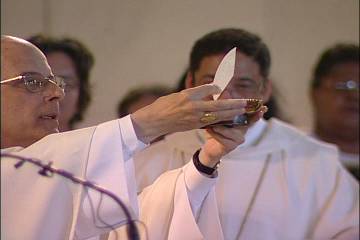
Bread of Life

BREAD OF LIFE
 this is the bread that comes down from heaven so that one may eat it and not die. (john 6: 50)
The miracle of God’s physical presence to us at every Mass is the truest testament to Christ’s love for us and His desire for each of us to have a personal relationship with Him. Jesus Christ celebrated the first Mass with His disciples at the Last Supper, the night before He died. He commanded His disciples, “Do this in remembrance of me” (Luke 22:19). The celebration of the Mass then became the main form of worship in the early Church, as a reenactment of the Last Supper, as Christ had commanded. Each and every Mass since commemorates Jesus’ sacrifice on the cross through the Holy Eucharist. Because the Mass “re-presents” (makes present) the sacrifice on Calvary, Catholics all around the world join together to be made present in Christ’s timeless sacrifice for our sins. There is something fascinating about continuing to celebrate the same Mass—instituted by Christ and practiced by the early Church—with the whole community of Catholics around the world…and in heaven.

THE REAL PRESENCE

Why does the Catholic Church believe Christ is really present in the Eucharist?
The Catholic doctrine of the Real Presence is the belief that Jesus Christ is literally, not symbolically, present in the Holy Eucharist—body, blood, soul and divinity. Catholics believe in the Real Presence of Christ in the Eucharist because Jesus tells us this is true in the Bible:

“I am the bread of life. Your fathers ate the manna in the wilderness, and they died. This is the bread which comes down from heaven, that a man may eat of it and not die. I am the living bread which came down from heaven; if any one eats of this bread, he will live for ever; and the bread which I shall give for the life of the world is my flesh." The Jews then disputed among themselves, saying, ‘How can this man give us his flesh to eat?’ So Jesus said to them,

"Truly, truly, I say to you, unless you eat the flesh of the Son of man and drink his blood, you have no life in you; he who eats my flesh and drinks my blood has eternal life, and I will raise him up at the last day. For my flesh is food indeed, and my blood is drink indeed. He who eats my flesh and drinks my blood abides in me, and I in him” - John 6:48-56
Furthermore, the early Church Fathers either imply or directly state that the bread and wine offered in the celebration of the Lord’s Supper is really the body and blood of Jesus Christ. In other words, the doctrine of the Real Presence that Catholics believe today was believed by the earliest Christians 2,000 years ago!

This miracle of God’s physical presence to us at every Mass is the truest testament to Christ’s love for us and His desire for each of us to have a personal relationship with Him.

Showing posts with label St. Cyril of Jerusalem. Show all posts

Friday, February 22, 2013

EFFECTS OF HOLY COMUNION

Since the earliest times, the benefits of receiving the Body and Blood of Christ were spelled out to encourage frequent, even daily, Holy Communion.

Thus, St. Cyril of Jerusalem (died 387) said that reception of the Eucharist makes the Christian a "Christbearer" and "one body and one blood with Him" (Catecheses, 4,3). St. John Chrysostom (died 407) speaks of a mixing of the Body of Christ with our body, "…in order to show the great love that He has for us. He mixed Himself with us, and joined His Body with us, so that we might become one like a bread connected with the body" (Homily 46,3). These and other comparisons of how Communion unites the recipient with Christ are based on Christ's own teaching, and St. Paul's statement that, "the bread which we break, is it not the partaking of the Body of the Lord? For we, being many, are one bread, all that partake of this bread." (I Corinthians 10:16-17).

So, too, the church officially teaches that "Every effect which bodily food and bodily drink produce in our corporeal life, by preserving this life, increasing this life, healing this life, and satisfying this life - is also produced by this Sacrament in the spiritual life" (Council of Florence, November 22, 1439). Thus:

1. Holy Communion preserves the supernatural life of the soul by giving the communicant supernatural strength to resist temptation, and by weakening the power of concupiscence. It reinforces the ability of our free will to withstand the assaults of the devil. In a formal definition, the Church calls Holy Communion "an antidote by which we are preserved from grievous sins" (Council of Trent, October 11, 1551).

2. Holy Communion increases the life of grace already present by vitalizing our supernatural life and strengthening the virtues and gifts of the Holy Spirit we possess. To be emphasized, however, is that the main effect of Communion is not to remit sin. In fact, a person in conscious mortal sin commits a sacrilege by going to Communion.

3. Holy Communion cures the spiritual diseases of the soul by cleansing it of venial sins and the temporal punishment due to sin. No less than serving as an antidote to protect the soul from mortal sins, Communion is "an antidote by which we are freed from our daily venial sins" (Council of Trent, October 11, 1551). The remission of venial sins and of the temporal sufferings due to sin takes place immediately by reason of the acts of perfect love of God, which are awakened by the reception of the Eucharist. The extent of this remission depends on the intensity of our charity when receiving Communion.

4. Holy Communion gives us a spiritual joy in the service of Christ, in defending His cause, in performing the duties of our state of life, and in making the sacrifices required of us in imitating the life of our Savior.

On Christ's own promise, Holy Communion is a pledge of heavenly glory and of our bodily resurrection from the dead (John 6:55). St. Irenaeus (died 202) simply declared that, "when our bodies partake of the Eucharist, they are no longer corruptible as they have the hope of eternal resurrection" (Against the Heresies, IV, 18,5).

Pocket Catholic Catechism, John A. Hardon, S.J., An Image Book, Published by Doubleday Copyright © 1989 by John A. Hardon, All Rights Reserved

Tuesday, July 31, 2012

THE REAL PRESENCE OF OUR LORD IN THE HOLY EUCHARIST

circa 350 A.D.: St. Cyril of Jerusalem
Catecheses, Lecture 22, ss. 1,3-6,9
(cf. Lecture 19, s. 7; Lecture 23, ss. 20-23)

On the night he was betrayed out Lord Jesus Christ took bread, and when he had given thanks, he broke it and gave it to his disciples and said: ``Take, eat: this is my body.'' He took the cup, gave thanks and said: ``Take, drink: this is my blood.'' Since Christ himself has declared the bread to be his body, who can have any further doubt? Since he himself has said quite categorically, This is my blood, who would dare to question and say that it is not his blood?

Therefore, is is with complete assurance that we receive the bread and wine as the body and blood of Christ. His body is given to us under the symbol of bread, and his blood is given to us udner the symbol of wine, in order to make us by receiving them one body and one blood with him. Having his body and blood in our members, we become bearers of Christ and sharers, as Saint Peter says, in the divine nature.
Once, when speaking to the Jews, Christ said: Unless you eat my flesh and drink my blood you shall have no life in you. This horrified them and they left him. Not understandoing his words ina spiritual way, they thought the Savior wished them to practice cannibalism.

Under the old dispensation there was showbread, but it came to an end with the old dispensation to which it belonged. Under the new covenant there is bread from heaven and the cup of salvation. These sanctify both soul and body, the bread being adapted to the sanctification of the body, the Word, to the sanctification of the soul.

Do not, then, regard the eucharistic elements as ordinary bread and wine: they are in fact the body and blood of the Lord, as he himself has declared. Whatever your senses may tell you, be strong in faith.

You have been taught and you are firmly convinced that what looks and tastes like bread and wine is not bread and wine but the body and blood of Christ. You know also how David referred to this long ago when he sang: Bread gives strength to man's heart and makes his face shine with the oil of gladness. Strengthen your heart, then, by receiving this bread as spriritual bread, and bring joy to the face of your soul.

May purity of conscience remove the veil from the face of your soul so that by contemplating the glory of the Lord, as in a mirror, you may be transformed from glory to glory in Christ Jesus our Lord. To him be glory for ever and ever. Amen.