Bread of Life

BREAD OF LIFE
 this is the bread that comes down from heaven so that one may eat it and not die. (john 6: 50)
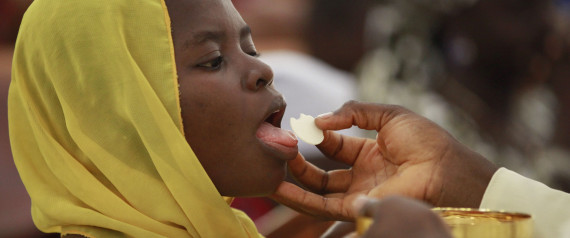
The miracle of God’s physical presence to us at every Mass is the truest testament to Christ’s love for us and His desire for each of us to have a personal relationship with Him. Jesus Christ celebrated the first Mass with His disciples at the Last Supper, the night before He died. He commanded His disciples, “Do this in remembrance of me” (Luke 22:19). The celebration of the Mass then became the main form of worship in the early Church, as a reenactment of the Last Supper, as Christ had commanded. Each and every Mass since commemorates Jesus’ sacrifice on the cross through the Holy Eucharist. Because the Mass “re-presents” (makes present) the sacrifice on Calvary, Catholics all around the world join together to be made present in Christ’s timeless sacrifice for our sins. There is something fascinating about continuing to celebrate the same Mass—instituted by Christ and practiced by the early Church—with the whole community of Catholics around the world…and in heaven.

THE REAL PRESENCE

Why does the Catholic Church believe Christ is really present in the Eucharist?
The Catholic doctrine of the Real Presence is the belief that Jesus Christ is literally, not symbolically, present in the Holy Eucharist—body, blood, soul and divinity. Catholics believe in the Real Presence of Christ in the Eucharist because Jesus tells us this is true in the Bible:

“I am the bread of life. Your fathers ate the manna in the wilderness, and they died. This is the bread which comes down from heaven, that a man may eat of it and not die. I am the living bread which came down from heaven; if any one eats of this bread, he will live for ever; and the bread which I shall give for the life of the world is my flesh." The Jews then disputed among themselves, saying, ‘How can this man give us his flesh to eat?’ So Jesus said to them,

"Truly, truly, I say to you, unless you eat the flesh of the Son of man and drink his blood, you have no life in you; he who eats my flesh and drinks my blood has eternal life, and I will raise him up at the last day. For my flesh is food indeed, and my blood is drink indeed. He who eats my flesh and drinks my blood abides in me, and I in him” - John 6:48-56
Furthermore, the early Church Fathers either imply or directly state that the bread and wine offered in the celebration of the Lord’s Supper is really the body and blood of Jesus Christ. In other words, the doctrine of the Real Presence that Catholics believe today was believed by the earliest Christians 2,000 years ago!

This miracle of God’s physical presence to us at every Mass is the truest testament to Christ’s love for us and His desire for each of us to have a personal relationship with Him.

Showing posts with label Baptism. Show all posts

Saturday, March 19, 2016

WHY DO CATHOLICS PRACTICE CONFESSION OF SINS TO A PRIEST?

A Protestant Christian friend of mine wanted to know why Catholics confess sins to a priest rather than straight to God.

He quoted 1 Tm 2:5 from the Bible to explain that Christ is the one true mediator between God and man.

He therefore felt that the Church did not have the authority to require confession of sins to a mediator (a priest).

Here my response to his question.

Well it's a fair question, and is certainly a loaded one. And it's certainly one that I have thought about myself. What it comes down to is that Christ is the one true mediator between God and man. But how he accomplishes the mediation is his choice.

Upon ascending into heaven Christ instituted a church that would be his earthly guide for all nations. A church that would be protected and guided by the Holy Spirit, to preserve his Christian truths and guide all men to Jesus for their salvation. Essentially, this is where the Catholic Church came from. It was founded on Peter, the first of the popes. In the gospel of Matthew, Jesus tells Simon after his confession of faith:

"Blessed are you, Simon, son of Jonah. For flesh and blood has not revealed this to you, but my heavenly father. And so I say to you, you are Peter, and upon this rock I will build my church and the gates of the netherworld shall not prevail against it. I will give you the keys to the kingdom of heaven; and whatever you bind on earth shall be bound in heaven; and whatever you loose on earth shall be loosed in heaven." --Matthew 16:17-19

Basically, in this passage Jesus does a curious thing. He changes Simon's name to Peter. Peter translated into Aramaic (the language of Jesus and his apostles) is Kepha, or rock. So what Jesus did was say that Peter is the rock. Not just any rock, but the rock on which he will build his church.

Jesus also says that the church would be infallible and would preserve his truths when he says "the gates of the netherworld shall not prevail against it..." (knowing the truth of Christianity certainly is necessary to be saved). He also gives Peter binding and loosing powers as well as the keys of heaven (strong symbols of authority) thus giving Peter ultimate teaching authority over the church.

In order to preserve this authority and give the gift of teaching to the church, it had to be preserved from error in the future. This is why the successors of Peter have always been the leaders of the Church.

True ability to interpret scripture and preserve the teachings of Christ are only fully possible within the Catholic Church. This is evidenced by the wide array of Protestantism, which hold a large amount of conflicting teachings (an example is the necessity of Baptism) even though all claim to be interpreting the Bible correctly.

Although much truth exists in other Christian religions, the only infallible truth lies within the Bible and the Traditions of the Catholic Church. If Christ had not established a teaching, living, apostolic church then how could we properly understand the doctrines of the Bible? Note that 2 Peter 1:20 says "know this first of all, that there is no prophecy of scripture that is a matter of personal interpretation".

And even the Ethiopian eunuch on his way to Damascus while trying to interpret scripture asks for Philip's help (who is ordained as a priest in Acts 6:5). "Philip ran up and heard him reading Isaiah the prophet and said, "Do you understand what you are reading?"

He replied "How can I unless someone instructs me?" (Acts 8:30-31) Thus the church has the authority to properly teach the doctrines of faith for our salvation. This is why I am Catholic. Because without the Church I can't be sure that Christ's teachings are being properly preserved.

If you read the Father's of the Church their writings correlate with Catholic views on a ministerial priesthood, the sacraments and many other Catholic doctrines. The first Christians themselves were Catholics. Acts 6:1-6 shows the establishment of the priesthood under the apostles of the Church.

In the end, it is the divinely ordained teaching authority of the Church that assures me of the validity and necessity of the Christian Sacraments; especially that of Confession. The sacrament of reconciliation (confession), the Church teaches, is the normative, necessary means by which a Christian receives the forgiveness of God.

The efficacy of confession is derived from Christ’s sacrificial death on the cross, where he served as the divine substitute for our transgressions. Not only does the Church teach the need of regular confession, but the Bible also records Christ’s institution of the sacrament following his resurrection from the dead when he first appeared to the assembly of apostles (John 20:19-23):

On the evening of the first day of the week, when the doors were locked, where the disciples were, for fear of the Jews, Jesus came and stood in their midst and said to them, “Peace be with you.” When he had said this he showed them his hands and his side. The disciples rejoiced when they saw the Lord. Jesus said to them again, “Peace be with you. As the Father has sent me, so I send you.” And when he said this, he breathed on them and said to them, “Receive the holy Spirit. Whose sins you forgive are forgiven them, and whose sins you retain are retained.”
This moment, when Jesus breathed on his apostles, constituted both the institution of the Catholic ministerial priesthood and the sacrament of confession. Christ gave his first priests, the apostles, the authority to forgive and retain sins.

It was his intention that all sin be forgiven though the Church by aural confession of sins to the priests. We should realize that in Holy Scripture God breathed on man only twice: once when he breathed life into the clay of earth to create man (Genesis 2:7) and the second time when he breathed the life of grace into his Church.

Both instances were that of an intimate, riveting moment between God and man. It is clear that the ability to forgive and retain sin given to the apostles, requires that each of us (even to this day) confess our sins to the priests of the Church so that our sins can be forgiven or retained.

As Christ well knew, confession of sins to a priest requires humility, trust in God and the Church, and contrition of heart. Confession of sins to a priest gives us the assurance that our sins are forgiven, even though we may not be perfectly penitent.

For that is what God requires outside the bounds of sacramental confession: a man who goes directly to God for forgiveness of sin can be forgiven, but only if he is perfectly contrite and resolved to sin no more. Those who are outside the Church by birth and circumstance can still be saved and forgiven of sins, but only if they are perfectly penitent and are unaware of the divine institution of the Church.

A Catholic who will not consent to a sacramental confession, is the man the Church grieves for the most. He has all the instruments of salvation laid out at his feet, but he will not lay his pride down at the foot of the Cross to pick them up.

I know sacramental confession often seems like a frightening, humiliating act for those who have neglected the sacrament for many years. I myself, after deciding to return to full communion with the Church, had to endure a heart-pounding moment of decision in which I laid down my pride and returned to the confessional. I found that the priest was compassionate, gentle and welcoming.

He realized that my presence there was an act of God’s grace. No priest will ever condemn a penitent man; and since then I have always found this to be the rule. Over time, confessions become less frightening; but they always require a measure of humility and resolve.

Yet, nothing in the world can compare to the joy of the soul after a good confession. The veil of sin falls away and the light of grace fills the soul. In the end, nothing in the world is as precious as the forgiveness of sin through the Sacrament of Reconciliation.

--S.M.M.

Monday, January 11, 2016

WHY INFANT BAPTISM?

Holy Baptism is the first of seven Sacraments in the Orthodox Christian Church. Together with the Sacrament of Holy Chrism it joins the candidate to the Mystical Body of Christ, the Church.

Some people argue that the only valid baptism is that of an adult who believes in Christ first.

They argue that to baptise a helpless infant only a few weeks old who is unable to believe is meaningless. So why baptise a baby when it doesn't know yet what is happening? Why not wait for the baby to grow and believe in Christ and ask for baptism?

If we were to follow this line of reasoning, we wouldn’t inoculate the baby against diphtheria until he grows up and asks for it! But we know better.

Baptising infants before they know what is going on is an expression of God's great love for us. It shows that God loves us and accepts us before we can ever know and love Him. It shows that we are wanted and loved by God from the very moment of our birth. Nothing shows the nature of God's grace more than infant baptism.

The Orthodox Church does not belittle personal faith in an adult who seeks baptism, but instead insists that the whole emphasis of baptism is not an what the baby does or the parents or the godparents, but on what God does. The fact that we are Christians is not due to any act on our part; it is due to the act of God in Christ through the Holy Spirit.

Of course Baptism demands a personal response on the part of the baptised child when it reaches the age of reason. The child must accept what God did for him or her in Baptism.

Baptism is not a divine pass that will get us into Heaven automatically. It must be followed by a personal awareness or awakening to the many gifts of God's love bestowed upon us through this great sacrament.

More > > >

Monday, November 24, 2014

IMPLICIT REPENTANCE

Baptism Provides Sanctifying Grace

Through the sin of Adam and Eve, the human race lost sanctifying grace. Baptism remedies this loss by providing sanctifying grace. However, another effect of original sin, the tendency toward personal sin, remains. Every valid Baptism provides the gift of sanctifying grace. The purpose of Baptism is to remedy the loss of sanctifying grace, a loss caused by original sin. Any Baptism that does not provide sanctifying grace is not a Baptism at all.

Baptism Forgives All Sin

What if an adult seeking Baptism has committed an actual mortal sin prior to Baptism? He cannot go to confession before he has been baptized. However, in the reception of the Sacrament of Baptism, he is forgiven from all past sins from which he is repentant. Notice, though, that there is no requirement that he confess or even call to mind his sins at the time of Baptism. He is forgiven by the grace of the Sacrament and by the choice of his own free to repent. His free will is necessary for his forgiveness from personal sin, just as it is necessary in the Sacrament of Reconciliation.

But what if an adult seeking Baptism has committed an actual mortal sin and is not repentant?

Some misguided theologians have claimed that, in this case, Baptism does not forgive his sin, and that he receives the Sacrament validly, yet without receiving sanctifying grace. They claim that he has the character or mark of Baptism on his soul, but without any fruitfulness (i.e. to no avail) until he confesses his past actual mortal sins. Baptism is the one and only remedy for the effect of original sin whereby we lack sanctifying grace. Yet this claim takes that gift and moves it to the Sacrament of Reconciliation, as if that Sacrament could in any circumstance remedy the stain of original sin. This entire concept of a fruitless or ineffective Baptism is heretical. For the Church has always taught, as a truth essential to salvation, that Baptism forgives all sins.

True doctrine on this point is that an adult Baptism is only valid if the adult, of his own free will, accepts the Sacrament of Baptism. His acceptance constitutes an implicit repentance from all past sins, mortal and venial, objective and actual. Thus Baptism forgives all sins, just as the Church has always taught, and actual mortal sin is only forgiven through repentance, just as the Church has always taught. Even though an individual might be unrepentant up to the very moment of his adult Baptism, and even though such a refusal by him to repent is unwise and imprudent and sinful, if and when he accepts the Sacrament of Baptism he has then acted with his free will in a manner that constitutes a real and full implicit repentance and all his past sins are forgiven him at the very moment of his Baptism, by the power of that Sacrament.

If an adult receives the Sacrament of Baptism, but without consenting to the Sacrament of his own free will, then the Sacrament is not valid and his sins are not forgiven. Neither is the stain of original sin removed or affected at all, because he is an adult who has not consented to the Sacrament. If he is unrepentant from actual mortal sin, and he also refuses to consent to the Sacrament of Baptism, then he has rejected even implicit repentance and the guilt of that actual mortal sin remains. Forgiveness from sin requires repentance from sin, at least implicitly.

Confession and Implicit Repentance

The Sacrament of Baptism has a greater power than the Sacrament of Reconciliation to forgive sins. For Baptism can forgive original sin as well as personal sin. But even the Sacrament of Reconciliation can forgive sins through implicit repentance. For it often happens that a penitent goes to Confession without calling to mind every actual mortal sin. But if he is generally repentant from sin, and if he confesses the mortal sins that he remembers, even when such a Confession is deeply flawed, he is forgiven from all his sins, mortal and venial, objective and actual. But if instead, he is obstinately and deliberately unrepentant from actual mortal sin, then he is not forgiven by the Sacrament of Confession, for there is no repentance, explicit or implicit.

Extreme Unction and Implicit Repentance

Implicit repentance is also found in the Sacrament of Extreme Unction (the Anointing of the Sick). If a baptized Catholic Christian is unconscious and near death, and he has an unrepented actual mortal sin on his conscience, the priest can give him the Sacrament of Extreme Unction, and it is possible, depending upon the state of his soul and the final acts of his free will, that he may be forgiven from that mortal sin by means of implicit repentance and the Sacrament of Extreme Unction, even if he never awakens before he dies.

Mystical Baptism and Implicit Repentance

A valid Sacrament of Baptism can be received through non-formal means, namely through a mystical Baptism. Since Baptism forgives all sins, a mystical Baptism must also forgive all sins. And, in this case also, a person might not be explicitly repentant from each prior actual mortal sin. Even so, the full cooperation with God's grace found within mystical Baptism contains an implicit repentance on the part of each person receiving a mystical Baptism. Therefore, even a non-formal Baptism forgives all sins, even past actual mortal sins from which the person receiving a mystical Baptism is not explicitly repentant. On the other hand, it is not possible to receive a mystical Baptism without at least implicit repentance from past actual mortal sins.

Conclusion

Every valid Baptism forgives all sins, mortal and venial, objective and actual, even those from which the candidate for Baptism has not explicitly repented. The acceptance of the Sacrament of Baptism by an adult, of his own free will, constitutes, in and of itself, an implicit repentance sufficient to permit the Sacrament of Baptism to forgive all sins. Without this acceptance of the Sacrament of Baptism by the free will, the Sacrament of Baptism itself would not be valid and the individual's sins would not be forgiven.

by Ronald L. Conte Jr.

November 5, 2006

Wednesday, October 2, 2013

ORIGINAL SIN

Behold, I was brought forth in iniquity, and in sin did my mother conceive me.

Psalm 51:5

Many people today deny the reality of original sin. Modern thinkers claim that evolution disproves it. Some object to the idea of inheriting sin from our parents, while others simply deny sin itself.

Some Christians claim that the Bible never teaches it and so on. However G.K. Chesterton while still an Anglican wrote in his book, Othrodoxy, that original sin is the most obvious of all Christian doctrines.

According to the Catechism of the Catholic Church (CCC), the doctrine of original sin is in some sense the reverse side of the doctrine of Redemption (CCC 389). In Genesis 2-3, God created man in His Image and established our first parents - Adam and Eve - in His friendship.

This friendship included Sanctifying grace - the gift of holiness and eternal life. Adam, however, freely chose to live apart from God by trusting instead in the knowledge of good and evil - wanting to be like gods.

Adam rejected God through disobedience and lost this friendship for himself and us. This loss is original sin (Gen 3:22ff; CCC 396-399).

The concept of original sin is not exclusively Catholic. Even though some Evangelical Protestants may shutter at the term, they readily acknowledge the fall of mankind and accept Jesus Christ as their Savior. Now without original sin, there would be no need for a Savior.

The story of Adam and Eve found in the Book of Genesis is inherited from our Hebrew heritage (Gen. 3). Even the ancient Greek pagans had an inkling idea of original sin and imperfectly expressed it in the tale of "Pandora's Box."

Now the doctrine of original sin cannot be proven by natural reason, but it is easily witnessed by its symptoms: the need for police, the collapse of great civilizations, suicide, suffering and so on. Another symptom is war. People have always and will always kill each other in mass quantity. The more advanced, civilized cultures merely execute war more efficiently. War is not exclusively reserved for nations. Street gangs, families or a single terrorist can rage war. But war is exclusively a human endeavor.
Monkeys, though nimble with their fingers, do not make bombs, guns or even knives. Man on the other hand has fashioned the most primitive weapons out of stone before he could record history.

In recent years, man has successfully sent robots to explore distant planets but still lives under the threat of nuclear holocaust.

Even though man is intelligent and capable of doing great works, war quickly reminds us of our fallen state - a state sometimes appearing to be beneath animals. Without the doctrine of original sin, this paradox of humanity is an even deeper mystery.

Modern thinkers may claim that evolution disproves original sin, even though evolution is still only a theory. Even if evolution were proven to be fact, fossils can tell us little about our first parents and their spiritual souls.

Also recent research in human mitochondrial DNA tends to indicate that the human race descended from a single woman - perhaps scientific evidence for Eve. (Mitochondrial DNA is genetic material inherited only from the mother and not from the father, unlike nuclear DNA.)

Now evolution does not disprove original sin, but on the contrary - sin seems to disprove evolution. Evolution does not explain man's sinful setback. If man evolved from animals, then man also shares a common digression missing among animals.

Some may object to the idea of inheriting sin; however, these people forget about human solidarity - the human race as one big family. Even though we are responsible for our actions due to human free will, our deeds still affect other people and vice versa. If I drive while drunk, my action can deprive someone else of their life.

If my children see me stealing, then they will more likely choose to steal as a result of my example and so on. Now original sin is not due to our action, so it is not our personal fault (CCC 405).

However as a result of human solidarity and Adam as the father of the human race, we still inherit the state of Adam's sin - "a human nature deprived of original holiness and justice" [CCC 404].

This disharmony between human free will and human solidarity is a consequence of original sin. Others may not only deny original sin, but deny sin altogether.

For example socialists try to replace personal responsibility for human behavior with impersonal forces, such as unequal distribution of wealth.

Humanists reduce personal sins to social problems and believe that man can eventually solve all problems - seeing no need for a divine Savior.

Other thinkers may not want to acknowledge their own personal sins, even though they readily recognize when others trespass against them. These thinkers arrogantly deny man's fundamental weakness and dependence on God, our Creator.

Now the term "Original Sin" may not be found in the Bible; however, the doctrine is present. King David refers to it in Psalm 51:5 (see top). Job declares in poetic fashion:

Man that is born of woman is of few days, and full of trouble...Who can bring a clean thing out of an unclean? There is not one. [Job 14:1 & 4; RSV]

Both of these passages imply that our sinfulness is inherited from our parents, even though there is no mention of Adam's sin.

The clearest revelation on original sin is found in the Epistles of St. Paul, especially Romans 5:12-20. St. Paul writes:

Then as one man's trespass led to condemnation for all men, so one man's act of righteousness leads to acquittal and life for all men. For as by one man's disobedience many were made sinners, so by one man's obedience many will be made righteous. [Rom 5:18-19]

Adam's original disobedience made us all sinners, while Christ's obedience on the Cross saves us from our sins. St. Paul also writes: Therefore as sin came into the world through one man and death through sin, and so death spread to all men because all men sinned. [Rom 5:12]

Adam's sin also brought death; however, death here should not be merely thought of in terms of bodily death as that which all animals experience but in a spiritual sense, as in the loss of eternal life (CCC 403).

This passage also implies that even though Adam brought death into the world, we are also responsible since we all sinned. Elsewhere St. Paul writes:

For as by a man came death, by a man has come also the resurrection of the dead. For as in Adam all die, so also in Christ shall all be made alive. [1 Cor 15:21-22]

According to these passages, we inherited sin and death as a result of Adam's sin. This is why St. Paul reminds us that "we were by nature children of wrath." [Eph 2:3]

This situation should not be considered as totally hopeless. Adam's sin earned us a Redeemer from sin and death. (Gen. 3:15) From the Mass on Holy Saturday: "Oh happy fault, O necessary sin of Adam, which gained for us so great a Redeemer!" As a result of original sin, we need Jesus Christ.

This sin gave God the opportunity to share His Only Son with us. Christ's victory over sin won us more blessings than those lost through Adam's sin (CCC 420).

In the words of St. Paul, "where sin increased, grace abounded all the more." [Rom 5:20] God worked through Adam's sin for our greater good and His Glory.

Through Christ's Resurrection, Baptism re-establishes God's friendship with us by washing away this sin from our soul (1 Peter 3:21). In Baptism we receive Sanctifying grace and are born again into eternal life (John 3:5). Sanctifying grace makes us pleasing to God (CCC 2024).

Baptism does not cancel all the effects of Adam's sin, such as concupiscence -the inclination to evil (CCC 405). But it and the other Sacraments give us the grace needed to "work out (our) own salvation with fear and trembling." [Phil 2:12].

In summary the symptoms of original sin demonstrate our need for God. Original sin is the loss of original holiness and justice due to Adam's sin. As a result man is alienated from God and also other men. Man has a wounded nature inclined towards evil.

A denial of this fact can only lead to serious errors in education, politics, social action and morals (CCC 407). The revelation of original sin cannot be compromised without also compromising the revelation of our Salvation.

Printed with permission from A Catholic Response, Inc.

Friday, November 30, 2012

REFLECTION ON ST. PAUL'S LETTER TO THE GALATIONS 5: 18 - 25

Brothers and sisters: If you are guided by the Spirit, you are not under the law. Now the works of the flesh are obvious: immorality, impurity, licentiousness, idolatry, sorcery, hatreds, rivalry, jealousy, outbursts of fury, acts of selfishness, dissensions, factions, occasions of envy, drinking bouts, orgies, and the like. I warn you, as I warned you before, that those who do such things will not inherit the Kingdom of God.

In contrast, the fruit of the Spirit is love, joy, peace, patience, kindness, generosity, faithfulness, gentleness, self-control. Against such there is no law. Now those who belong to Christ Jesus have crucified their flesh with its passions and desires. If we live in the Spirit, let us also follow the Spirit.

Reflection:

The final selection from Paul’s letter to the Galatian Christians softens the tone of the earlier chapters. We hear in this final chapter a beautiful passage of the Holy Spirit. We could say that everything Paul wrote to the Galatians up till now is expressed in the final verse. “If we live by the Spirit, let us also be guided by the Spirit” (Gal 5:25). The Spirit gives life at baptism, communicating supernatural gifts that transcend the purely human qualities with which we are born. Theologians consider the sever traditional gifts of the Holy Spirit to be supernatural and permanent, given by God to make a baptized person attentive to the voice of God; receptive to the workings of grace; zealous for the things of God; and, consequently, obedient and docile to the inspirations of the Holy Spirit.

Paul argued throughout the letter to the Galatians against the power of the Mosaic Law to save a person. He concludes now by saying that people who live according to the free gifts of the Spirit will produce the fruit (not fruits) of the Spirit, that is, love, joy, peace, patience, kindness, generosity, faithfulness, gentleness, and self-control. It’s a partial list, as Paul says that “there is no law against such things,” because they show that Christ lives and acts in those who produce such fruit. As Jesus had said so clearly, “A tree is known by its fruit” (Luke 6:44).

Sunday, April 22, 2012

FINDING THE TRUTH: TRUE LOVE

God is love. And God created Heaven and Earth to share in His love. God did not create toys to play with or slaves to boss around. He created creatures who could share in His love as equals, so to speak, in love. He gave us His love so that we could be love.

Because of the blindness that characterizes our separation from God, however, we can see nothing but our own self-indulgent illusions. Left to ourselves, we have nothing but an empty world of social constructions to give us comfort. Left to ourselves, we have nothing but pride, and in that pride we are easily deceived by evil. Left to ourselves, therefore, we are lost in slavery to sin. Therefore, only God Himself can show us what true love is.

Now, if God were to appear to us in His full glory, we would surely drop down before Him in terror. But we wouldn’t necessarily love Him. True love, after all, is an act of self-sacrifice offered in free will, not something engendered by fear.
Psychologically, fear refers to a narcissistic concern about possible damage to our pride and safety. In contrast, fear of God refers to our humble awe before God’s great glory and mercy. Thus, whereas psychological fear pulls us away from God, fear of God leads us directly into the embrace of divine love.
So, in order to teach us true love, God chose to show it to us through the life of a simple, poor man—a life which ended with the most humiliating execution known to humanity.

It was as if God said to all bystanders, those present and those yet to be, “If you can love Him, My Son, this humble, broken man hanging in weakness on that cross out of love for you, you can love anything. If you can love anything, you will know true love. And if you know true love, you will finally begin to know Me.”
After all, what, in all its blindness, does human culture tend to value? Well, look at politics, sports, and entertainment and you will see an insatiable thirst for wealth, glamor, power, competition, and revenge. So is it any wonder that to show us true love, and to bypass all human illusions, God came to us in poverty, simplicity, weakness, and gentleness?
Christ took all of the insults patiently and quietly, without retaliation, all so that we could see the truth of the sin in our hearts—and repent it, in sorrow for the pain we cause to each other.

And that’s why Saint Paul said (1 Corinthians 1:23) that the crucifixion of Christ seemed like folly to the Greeks who valued the “wisdom” of natural philosophy; and to the Jews, who looked for powerful prophetic signs, the crucifixion was a stumbling block.

For neither natural wisdom nor power can illuminate their own darkness.

Baptism into Christ, therefore, calls us to a radical change in our being. In the language of computer technology, it’s like saying that true Christian faith is not just an “application” that we can run on our existing “operating systems”; true faith is a process that creates an entirely new operating system.

Thursday, March 29, 2012

GRACE: A PRECIOUS GIFT OF GOD

For by grace you are saved through faith, and that not of yourselves, for it is the gift of God.--Ephesians 2:8

The Death and Resurrection of Christ

Christ’s death and resurrection changed the world forever. No one can deny that the birth of Christianity, which rose with Jesus in the Resurrection, would lay the foundation for a new and changed world. Most Christians can find a seed of common ground in the belief that Jesus’ death was a sacrificial one. His death was not one in vain, but one in which all human sins and offenses against God’s love could be paid for by Christ’s sacrifice for the sins of the world. The blood of our Savior redeemed the world and opened the gates of heaven so that humans could partake in justification of their sins.

Our God is supremely just and the essence of the purest good. The sins of evil, which permeated the human race, placed a chasm between our all-good and just Creator and us. God could not allow humanity, tainted in sin, to embrace him in his fullness in heaven. His infinite justice could not allow for sin to go unpunished. Yet his love for humanity was so great that he could not abandon his children to the hatred of Satan and an eternity of pain and suffering. God’s mercy and continuous cries to his people, through the Jewish prophets, went largely unheeded. So God, in the second person of the Trinity, assumed the nature of man to teach his people and atone for the sins of man by the human death of the Son of God, Jesus Christ. This fundamental mystery was the highest act of love and beatitude to ever grace creation. Christ’s willing, fleshly sacrifice paid for the collective guilt of humanity as Christ took on the sins of the human race for all time. He saved our souls and captured the hearts and lives of the first Christians and those who followed.

Grace

God’s gift of salvation was one of pure love. He desired humanity to join him in heaven, but he could not force us to accept his gift of love. Upon creating humans, he endowed us with free will so that we could freely return his infinite love with love. Thus God could only attribute the salvation of Christ’s passion (his crucifixion and resurrection) to those who freely returned his love in faith and hope.
Human experience shows that people often have a tendency to draw toward evil and selfish passions. This misplaced love for the things of our natural world is a result of the original sin of mankind and the continuing temptation of Satan. In order to help humanity choose God over selfishness and temporal happiness, the crucifixion of Jesus brought forth a new gift: the gift of grace.
Grace is the free and undeserved help that God gives us to respond to his call. The Church teaches us that grace moves us to participate in the life of God and moves us to begin and sustain a relationship with our Creator. Grace not only assists us in living the Christian life through purification of our hearts, it literally changes our souls by infusing divine life to heal the wounds of sin. Grace is wrought through the work of the Holy Spirit, and grace is what initially moves our hearts to conversion and repentance.

A baptism into grace

Sanctifying grace is the grace we receive in the sacrament of Baptism. Sanctifying grace, when infused in the soul, breathes supernatural life into the soul, heals it of sins and upon death allows us to enjoy the fullness of God’s beatitude in heaven. Without sanctifying grace the soul is lifeless and a slave to sin. It is not possible for humans to merit the kingdom of heaven without the gift of sanctifying grace paid for by Christ’s redemptive suffering, death, and resurrection.

St. Paul in his letter to the Romans asks "…are you unaware that we who were baptized into Christ Jesus were baptized into his death? We were indeed buried with him through baptism into death, so that, just as Christ was raised from the dead by the glory of the Father, we too might live in newness of life (Rom 6:3-4)." Thus Paul notes that baptism confers on us a newness of life which the Church teaches us is sanctifying grace.

This is why baptism is the vital first step in the life of a Christian. Jesus tells us in the gospel of John, "Amen, amen, I say to you, no one can enter the kingdom of God without being born of water and Spirit (John 3:5)." Thus the cleansing waters of baptism wash away the inequities of sin and through the grace of God begin a sustaining relationship in Christ through the work of the Holy Spirit. Christ reminds us that "whoever believes and is baptized will be saved. Whoever does not believe will be condemned (Mk 16:16)."

A second kind of grace—Actual graces

Although sanctifying grace instills us with life, there are moments in our lives in which we are especially moved by God’s love. These graces help us to sustain our relationship with Christ and are called actual graces, because they reflect the intervention of God in our lives. Actual grace is what moves a person’s heart to conversion and penitence and sustains the soul in the process of justification and sanctification.

The seven sacraments of the Church are also a work of actual grace to nourish the Body of Christ and its members. The Eucharist, as the central sacrament, provides the body, blood, soul and divinity of Christ as the heavenly food for the soul. Christ promises the sustaining life of grace in the Eucharist to his apostles, "I am the living bread that came down from heaven; Whoever eats this bread will live forever…(John 6:51)."

Special gifts of the Holy Spirit

The grace of the Spirit can also endow us with spiritual gifts called charisms. St. Paul tells us that these gifts take many forms such as ministry, a teacher of doctrine, prophecy, service, and zeal. Sometimes the gifts are extraordinary and miraculous, such as the gift of miracles or speaking in tongues. It is important to realize however that these gifts are meant not for the glorification of the recipient, but for the common good and service of the Church. The extraordinary gifts of tongues, miracles, interpreter of tongues and healing are not granted to all the members of the Church, but to certain individuals as decided on by the Holy Spirit. Such gifts are ordered to strengthening the faith of the Church and are oriented towards sanctifying grace.

Is it possible to cut ourselves off from Christ, and loose the sustaining gift of grace?

The Catechism of the church tells us "sins are rightly evaluated according to their gravity (CCC 1854)" and that there is a distinction between sins, that of mortal and venial sin. "Mortal sin destroys charity in the heart of man by a grave violation of God’s law; it turns man away from God, who is his ultimate end and his beatitude, by preferring an inferior good to him (CCC 1855)." Venial sin is a sin of less serious matter that weakens charity and impedes the exercise of virtue. The bible testifies to the differentiation between mortal and venial sin. St. John’s epistle tell us "there is such thing as deadly sin, about which I do not say that you should pray (1 Jn 5:16)". The Tradition of the Church affirms that mortal sin destroys sanctifying grace of the soul and cuts the sinner off from the body of Christ. Scripture again affirms Tradition when Jesus compares the Body of Christ, the church, to a vine. The members of the Church are warned by Christ, "Anyone who does not remain in me will be thrown out like a branch and wither; people will gather them and throw them into a fire and they will be burned (John 15:6)." Thus a sin of mortal nature cuts us off from the Body of Christ, until the sinner is moved to repentance in the Sacrament of Reconciliation.

Can the witness of grace assure us of our salvation?

The Church has always understood grace as a gift that can only be known through faith. Grace is a supernatural gift that escapes our experience, and thus cannot be known by feelings or good works (Council of Trent: DS 1533-1534). No human can definitively know that that they posses assured salvation, because it would mean that we have infallibility to judge our own souls, something that is reserved to God alone. Still, we can be assured by faith that grace will work through us to move us to acts of hope, love and charity for the glorification of Jesus Christ and his kingdom. Christ speaks of the loving aspect of grace and tells his disciples, "Thus you will know them by their fruits (Mt 7:20)" to testify that the grace of God would bear the fruit of charity in those who walk in the path of Jesus.

Conclusion

The redeeming nature of supernatural grace truly transforms the recipient into a new creature in Christ. As the supernatural life of the soul, grace is the most important treasure anyone could possibly be given. Thus those who fully understand the gift of grace can truly take to heart the ultimate sacrifice and love in Christ’s passion and resurrection.

--SMM


Bibliography

United States Catholic Conference (English translation). Catechism of the Catholic Church. 1994.

Holy Bible. New American Version. U.S.A: World Publishing Inc, 1987.

Wednesday, November 2, 2011

THE NEW ROMAN MISSAL

Scripture and the Mass (The New Roman Missal)
– from the United States Conference of Catholic Bishops

[Are you ready for the upcoming changes? Beginning with Advent a new English translation of the Roman Missal will be used in the United States. Below the U.S. Bishops Conference explains some of these changes.]

It is clear that Sacred Scripture has a revered and important place in the Eucharistic Liturgy. Every Mass includes a Liturgy of the Word. The main elements of the liturgy of the Word are biblical readings and the singing of the psalm. The Liturgy of the Word reaches its high point in the proclamation of the Gospel.
However, the use of Scripture in the Mass does not end when the Liturgy of the Word has finished. In fact, the words of Scripture flow throughout the prayers of the Mass. One of the goals of the new translation of the Missal was to make clearer the links between the prayers of the Mass and the text of Scripture. Some of the most noticeable changes reflect the words of the Bible more clearly. Let's take a look at some of these changes.
A BIBLICAL GREETING:

At several points in the Mass, the priest or deacon and the people engage in the following dialogue:

Priest or Deacon: The Lord be with you.
And with your spirit. (The Order of the Mass, 2)

The first words come from a greeting of Boaz, the great-grandfather of King David: "Boaz...said to the harvesters, 'The Lord be with you!' and they replied, 'The Lord bless you!'" (Ru 2:4). The people's response reflects the language of St. Paul. In Galatians, he says, "The grace of our Lord Jesus Christ be with you spirit, brothers. Amen" (Gal. 6:18); the Second Letter to Timothy closes with a similar wish: "The Lord be with your spirit" (2 Tim 4:22). The Letter to the Philippians ends with "The grace of the Lord Jesus Christ be with your spirit" (Phil 4:23).

The new language, though a bit unfamiliar to our ears, more directly reflects the biblical understanding that, through Baptism, the Spirit of God dwells in us and unites us as one Body in Christ.

WELCOMING THE LORD:

Immediately before coming forward to receive the Lord in Holy Communion, we welcome the Lord:

Lord, I am not worthy
that you should enter under my roof,
but only say the word
and my soul shall be healed. (The Order of Mass, 132)

This prayer quotes the words of the centurion who asked Jesus to cure his servant. He would not presume to ask Jesus to come to his home. He trusted in the authority of Jesus' healing word, saying: "Lord, I am not worthy to have you enter under my roof; only say the word and my servant will be healed" (Mt 8:8; see Lk 7:6-7). This new phrasing reminds us that, in receiving Holy Communion, we are to emulate the centurion's humility and faith.

FOR THE MANY:

One of the most notable changes will come in the words that the priest speaks in consecrating the wine as the Blood of Christ:

Take this, all of you, and drink from it:
for this is the chalice of my Blood,
the Blood of the new and eternal covenant,
which will be poured out for you and for many
for the forgiveness of sins. (The Order of Mass, 90)

The newly translated text more closely reflects the scriptural accounts of the Last Supper: "Then he took a cup, gave thanks, and gave it to them, saying, 'Drink from it, all of you, for this is my blood of the covenant, which will be shed on behalf of the many for the forgiveness of sins'" (Mt 26:27-28). Much attention has focused on a single change in this text: from "for all" to "for many." This change is unique to the English language. Other languages, including Spanish, French, and German, have already been using language that more closely reflects Jesus' words at the Last Supper.

This new text does not mean that God's love is limited or that only some may be saved. Rather, it reflects the fact that human beings may choose to accept the grace of salvation and live their lives in the light of this grace.

DEEPER UNDERSTANDING:

If we recognize the biblical references that underlie the liturgical texts, we will have a fuller understanding of their meaning. For example, Eucharistic Prayer I includes the following passage:

Be pleased to look upon these offerings
with a serene and kindly countenance,
and to accept them,
as you were pleased to accept
the gifts of your servant Abel, the just,
the sacrifice of Abraham, our father in faith,
and the offering of your high priest Melchizedek,
a holy sacrifice, a spotless victim. (The Order of Mass, 93)

If we do not know who Abel (Gn 4:4) and Melchizedek (Gn 14:18-20) are and if we do not understand the importance of Abraham's sacrifice (Gn 15:7-21; 22:1-14), we will not fully appreciate the concept of sacrifice and how our celebration of the eucharistic sacrifice ties us to our ancestors in the faith, from the very beginning.

THE WORD OF GOD IN SCRIPTURE AND THE EUCHARIST:

Translating the liturgical texts with a close eye to their correspondence with the texts of Scripture can help us to develop a greater appreciation of the close links between the prayers of the Mass and Sacred Scripture. These close links can help draw us more deeply into the theological meaning of the texts.

For example, before the Communion Rite, the priest breaks the Host and shows it to the people, saying:
Behold the Lamb of God,
behold him who takes away the sins of the world.
Blessed are those called to the supper of the Lamb.
(The Order of Mass, 132)

The first part of this prayer echoes the words of John the Baptist, heralding the coming of the Christ: "The next day he [John] saw Jesus coming toward him and said, 'Behold, the Lamb of God, who takes away the sin of the world'" (Jn 1:29). In the same way, we who are united in the Body of Christ in the Sacrament of Baptism and strengthened in the Eucharist are called to point others to Jesus through our words and actions.

The second part of this prayer reflects the words of the Book of Revelation: "Then the angel said to me, 'Write this: Blessed are those who have been called to the wedding feast of the Lamb'" (Rev 19:9). In this prayer, we are not rejoicing that we may receive the Eucharist. Instead, we rejoice for those who have been found worthy to share in the heavenly Liturgy, the supper of the Lamb, and we pray that one day, we may join them in the everlasting life of the Kingdom of God.

CONCLUSION:

By delving more deeply into the scriptural background of the Mass, we come to know more closely Jesus, the Word of God made flesh, whose Paschal Mystery we celebrate.

REFERENCES:
Excerpts from the English translation of the Roman Missal ©2010, International Commission on English in the Liturgy, Inc. (ICEL). All rights reserved

Scripture texts used in this work are taken from the New American Bible, Copyright ©1991, 1986, 1970 by the Confraternity of Christian Doctrine, Washington, DC 20017 and are used by permission of the copyright owner. All rights reserved.

Copyright © 2010, United States Conference of Catholic Bishops, Washington, DC. Gratis permission is hereby granted to reproduce these materials for nonprofit educational use, when accompanied by the following acknowledgment: "Copyright © 2010 United States Conference of Catholic Bishops, Washington, D.C. Used with permission. All rights reserved."

Saturday, September 3, 2011

SACRAMENT OF CONFIRMATION

The sacrament of confirmation completes the sacrament of baptism. If baptism is the sacrament of re-birth to a new and supernatural life, confir- mation is the sacrament of maturity and coming of age. The real confession of Christ consist in this 'that the whole man submits himself to Truth, in the judgment of his understanding, in the submission of his will and in the consecration of his whole power of love . . . To do this, poor-spirited man is only able when he has been confirmed by God's grace'

This confirmation in the power of the Holy Spirit leading to a firm profession of faith has always been the particular effect which Catholic tradition has ascribed to the sacrament. It is effect which complements and completes that of baptism.

THE CHURCH TEACHES:
Confirmation is a true sacrament instituted by Christ and different from baptism. It is administered by laying-on of hands and anointing with chrism accompanied by prayer. The chrism is blessed by the bishop and the bishop administers the sacrament. All baptized persons can and should be confirmed. The effect of the sacrament of confirmation is to give strength in faith and for the confession of faith and to impress an indelible character.


The Seven Sacraments
I.Baptism
II.Penance/Reconciliation
III.Eucharist
IV.Confirmation
V.Matrimony
VI.Holy Orders
VII.Extremunction or Anointing
of the Sick

Thursday, April 7, 2011

CONTRITION

Whose sins you shall forgive they are forgiven them, and whose sins you shall retain they are retained.--JOHN xx. 23.
INTRODUCTION. The words of the text were spoken by our Lord on the evening of the day of the Resurrection. The risen Saviour, appearing to the Apostolic group as they were gathered together behind closed doors, conferred upon them the wondrous power of forgiving and retaining sins. He gave them the faculty, not only to forgive, but also to retain sins, thereby showing that this power was to be exercised with discrimination, dependent upon the dispositions of the sinner. Accordingly the minister of Christ in the Sacrament of Penance is not allowed to give absolution, unless he judges there is contrition on the part of the penitent; and were he to absolve a sinner who had no sorrow for his sins, the absolution would be null and void. Let us meditate, therefore, today on contrition for sins, a most necessary condition for pardon.

I. The meaning of contrition: 1. Contrition is a sorrow and detestation of past sin, with a purpose of sinning no more. 2. Contrition includes two elements: (a) sorrow for the past; (b) a firm resolution of amendment for the future. Hence contrition requires forgiveness of injuries and the purpose of reparation and restitution, as far as necessary and possible, and of the avoidance of the occasions of sin. 3. Contrition is either perfect or imperfect (attrition) according as our sorrow springs from love of God; or from fear of punishment, hatred of sin, or other supernatural motive short of God's love. If one's dispositions are such that he would continue to sin except for the fear of punishment, his contrition is not sufficient for pardon.

II. The qualities of contrition: 1. Contrition must be interior, i.e., it must come from the heart. 2. It must be supernatural, i.e., its motive must spring from something suggested by faith, such as love of God, loss of heaven, and the like; it must not be a merely natural sorrow based on fear of temporal loss or punishment. 3. It must be universal, extending at least to all mortal sins. If only venial sins are confessed, sorrow must be had at least for one of them. 4. Contrition must be sovereign, i.e., the penitent, aside altogether from his sensible feelings, must realize that sin, as being against God, is the greatest of all evils.

III. The importance and efficacy of contrition: 1. An act of perfect contrition obtains pardon for sins at once, even before they are confessed, because it proceeds from love of God, which cannot co-exist with sin. 2. Perfect contrition, however, when there is question of mortal sins, must include the intention of confession, since Christ instituted the Sacrament of Penance as the sole means of forgiving grievous sins committed after Baptism.

EXHORTATION, 1. Make frequent examinations of conscience and acts of contrition, especially before going to sleep. 2. Frequently reflect on the motives of sorrow for sin. 3. Make a sincere act of contrition before going to confession, and remember that true contrition always requires a firm purpose of amendment.

Confession Index

Thursday, January 13, 2011

WHAT HAPPENS TO UNBAPTISED BABIES

Traditional Roman Catholicism

In the world today, a large number of people including infants, have never received the waters of baptism. In the new Catechism # 1261, it states: " hope that there is a way of salvation for children who die without baptism". This is a total rejection of the doctrine on original sin.

The Pelagian heresy was and is condemned by the Church. This heresy rejects original sin and thus denied that it was transmitted to infants. Saint Augustine, Father and Doctor of the Church, states:

" Likewise, whosoever says that those children who depart out of this life without partaking of that sacrament (Baptism) shall be made alive in Christ, certainly contradicts the apostolic declaration, and condemns the  universal church, in which it is the practice to loose no time and run in haste to administer baptism to infant children, because it is believed, as an indubitable truth, that otherwise they cannot be made alive, must  necessarily remain under the condemnation, of which the apostle says, " by the offence of one, judgment came upon all men to condemnation."

Letter 166: To Saint Jerome.

We must remember that it is heresy to say an unbaptized baby can be saved. In the doctrine on original sin, the Council of Florence declared: " The souls of those who die in actual mortal sin, or only in original sin, immediately  descend into hell." ( Denzinger # 693 )


The Council of Lyons II states:

" The souls of those who die in mortal sin, or with original sin only, however, immediately descend to hell, yet to  be punished with different punishments." (Denzinger # 464)


The Catechism of the Council of Trent, under Pope Saint Pius V states:

" If then through the transgression of Adam, children inherit original sin, with still stronger reason can they attain through Christ our Lord grace and justice that they may reign in life. This however, cannot be effected otherwise than through baptism. Pastors therefore should inculate the absolute necessity of administering baptism to infants, and of gradually forming their minds to piety by education in the Christian religion..... The faithful are earnestly to be exhorted to take care that their children be brought to the Church , as soon as it can be done with safety, to receive solemn baptism. Since infant children have no other means of salvation except baptism, we may easily understand how grievously those persons sin who permit them to remain without the grace of the  sacrament longer than necessity may require, particularly at an age so tender as to be exposed to numberless dangers of death."

So we see that those who die in "original sin only', which would be infants, descend immediately into hell. The limbo of unbaptized children is situated in hell. Although the punishments of hell are not the same as for those who commit actual sin. Pope John XXII (1316-1134) wrote :

" It ( the Roman Church) teaches.... that the souls...of those who die in mortal sin, or with only original sin descend immediately into hell; however, to be punished with different penalties and in different places."  ( Denzinger # 493a ).

Different punishments and different places of hell. Knowing this, why would anyone not rush to have their infants baptized? Even if the infant suffers no actual pain, again, why would anyone take the chance to have their infant be deprived of the Beatific Vision? To show another example of the belief in different places of hell we see:

" The wretched souls of the damned are distributed throughout places of punishment according to the nature of their sins, fearfully or less fearfully, as it is written: "Each one is bound fast by the ropes of his own sins(Proverbs 5:22) , and this is what is meant by the servant who is beaten with few stripes"(Luke12:48). For just as there are differences , so there are differences of punishments."

Saint Ephraim of Syrius (A.D. 372), doctor of the church. Sermon 72

Limbo, which in Latin is, "limbus", means edge. According to " A Catholic dictionary", "The limbo of children. It is of faith that all, children and adults, who leave this world without baptism of water, blood or desire, and therefore are in original sin are excluded from the vision of God in Heaven.

One last quote:

" The doctrine which rejects as a Pelagian fable, that place of the lower regions ( which the faithful generally designate by the name of the limbo of the children ) in which the souls of those departing with the sole guilt of original sin are punished with the punishment of the condemned, exclusive of the punishment of fire, just as if, by this vary fact, that these who remove the punishment of fire introduced that middle place and state free of guilt and of punishment between the kingdom of God and eternal damnation, such as that about which the Pelagians  idly talk , - false, rash, injurious to Catholic schools."

Pope Pius VI ( Denzinger # 1526 )

So we see the church officially teaches that all children, who do not receive the waters of baptism, cannot be in the Beatific vision, although they do not suffer the pains of hell, they are punished by the loss of the Beatific Vision. We must ask why the New Catechism contradicts the strict teaching on the necessity of baptism for salvation of infants. God has spoken in the Gospels, the Church has clearly taught the need for baptism of infants, yet the New Catechism somehow gives hope for those never baptized. This is a Pelagian heresy to say that there is hope. A rejection of the doctrine on original sin. The babies who die in abortion cannot and will not see God. This is an article of faith. They will not suffer the fire, but the fact that God created them to be with Him in heaven, should be enough for women not to take them away from God. Water Baptism is and always has been, the entrance to The Church, The Mystical Body of Christ and outside the Church, no one can be saved, not even babies. Please, make sure your child is baptized so that he or she can have the opportunity to go home to Heaven when God calls them. I end this with a quote from Saint Ambrose:

" No one ascends into the kingdom of Heaven except by the Sacrament of Baptism. No one is excused from Baptism: not infants, nor anyone hindered by any necessity. When the Lord Jesus came to John, and John said: "  I ought to be baptized by Thee, and dost Thou come to me? " Jesus said: " Permit it to be so for now. For thus it becometh us to fulfill all justice."

( Mt. 3: 14-15 ) Behold how all justice rests on Baptism! "

Saint Ambrose

Thursday, March 25, 2010

THE WOMAN AT THE WELL

The scriptural story of the woman at the well in John’s Gospel is a superlative example of the healing ministry Jesus Christ offers to his wounded followers. If we look in terms of Christ as the “wounded healer” in this narrative, the salvific role of the Paschal Mystery is indeed revealed in Jesus’ interactions with the Samaritan woman.

Jesus offers the Samaritan woman the opportunity to partake of living water as part of the conversion and restoration process. In a similar manner, all Catholic believers can identify with the Woman at the Well as a co-companion in the journey from sin to new life in Baptism. We believers share the same wounded human condition as the Samaritan woman and it is Jesus’ ultimate wounding at Calvary that heals us with living water.

Jesus is the wounded healer offering redemption and healing to the woman at the well and to us. During this pivotal period in the history of the Catholic Church, the age of healing has a new meaning as Benedict XVI promotes harmony and therapeutic spiritual healing between all brothers and sisters of humanity.

Jesus offers the portrait of healer for all of us to emulate in our lives. His ability to engage the Samaritan woman without prejudice and judgment is a great moment of cathartic revelation that reminds all of us of the,”sacred call “to conversion is the touchstone for all religious and human actions.

The woman at the well is a great example of the duality of ministry the Church offers to those already incorporated through Baptism, and those outside the Church that seek a graced harmonious relationship in global society. What I always find significant about the Samaritan woman is her distinction as a Samaritan. Jesus could just have easily offered his advice and counsel to a Jewish woman.

However, he engages a member of the separated Tribes of Israel the opportunity to confess, convert and be healed through the element of water. On a uniquely modern basis, our Church today is presented with worldwide opportunities to bridge misunderstandings of theology and history between all faiths. Religious dialogue directed towards universal harmony is a responsibility of all Catholic peoples while respecting other religions freedom of beliefs and autonomy.

In the story of the Woman at the Well, Jesus makes a simple request of water from the woman. He does not politicize, or theologically dissect her marital, religious or political situation. Rather he asks for life sustaining water, universally needed by all living things for life. However, there is a ironic duality going on here as well…Jesus is asking for water and is giving the opportunity for eternal water to the Samaritan woman. Perhaps as a Catholic community of believers, we need to contemplate this mystery.

We are not only the recipients of salvation but are also the dispensers of salvation through faith and Baptism. Catholic communion has a dual responsibility to both nourish and share spiritual nourishment with the larger global society without conditions, just Gospel love of God and neighbor.

Jesus interaction with the woman at the well is not only an opportunity for Jesus to be the Physician-Healer but also the Divine Therapist through the diagnostic questioning of the woman’s marital situation. While from an exegetical perspective the “life giving water” is clearly a sign of Baptism, it is also a deeply rooted suggestion of therapeutic healing through grace.

As participants in “wounding” and being “wounded” Catholic believers metaphysically call all peoples to a live filled and marked by radical transformations. As Catholics, we offer to the entire world the opportunity to participate in the Paschal Mystery and partake of Living Waters. This call to global fellowship is the cornerstone of potential human understanding of the universal mysteries of faith and our ultimate desire for global unity and harmony.

The pursuit of Living waters is healing, therapeutic, and unifying. As Catholic global believers, we offer all peoples the message of love and unification through Christ Jesus. A prayer from the Liturgy of the Hours perhaps best concludes this reflection:
Father, form in us the likeness of Christ your Son and strengthen His love within us. Touch the hearts of all with your love. Send us as witnesses of Gospel joy to a world of fragile peace and broken promises. Touch the hearts of all with your love, so we may love one another.