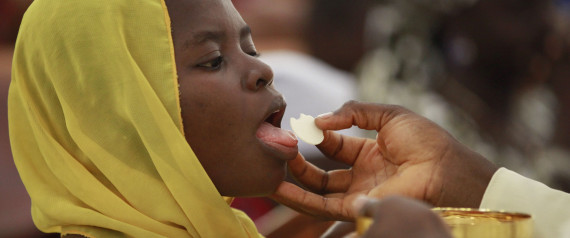
Bread of Life

BREAD OF LIFE
 this is the bread that comes down from heaven so that one may eat it and not die. (john 6: 50)
The miracle of God’s physical presence to us at every Mass is the truest testament to Christ’s love for us and His desire for each of us to have a personal relationship with Him. Jesus Christ celebrated the first Mass with His disciples at the Last Supper, the night before He died. He commanded His disciples, “Do this in remembrance of me” (Luke 22:19). The celebration of the Mass then became the main form of worship in the early Church, as a reenactment of the Last Supper, as Christ had commanded. Each and every Mass since commemorates Jesus’ sacrifice on the cross through the Holy Eucharist. Because the Mass “re-presents” (makes present) the sacrifice on Calvary, Catholics all around the world join together to be made present in Christ’s timeless sacrifice for our sins. There is something fascinating about continuing to celebrate the same Mass—instituted by Christ and practiced by the early Church—with the whole community of Catholics around the world…and in heaven.

THE REAL PRESENCE

Why does the Catholic Church believe Christ is really present in the Eucharist?
The Catholic doctrine of the Real Presence is the belief that Jesus Christ is literally, not symbolically, present in the Holy Eucharist—body, blood, soul and divinity. Catholics believe in the Real Presence of Christ in the Eucharist because Jesus tells us this is true in the Bible:

“I am the bread of life. Your fathers ate the manna in the wilderness, and they died. This is the bread which comes down from heaven, that a man may eat of it and not die. I am the living bread which came down from heaven; if any one eats of this bread, he will live for ever; and the bread which I shall give for the life of the world is my flesh." The Jews then disputed among themselves, saying, ‘How can this man give us his flesh to eat?’ So Jesus said to them,

"Truly, truly, I say to you, unless you eat the flesh of the Son of man and drink his blood, you have no life in you; he who eats my flesh and drinks my blood has eternal life, and I will raise him up at the last day. For my flesh is food indeed, and my blood is drink indeed. He who eats my flesh and drinks my blood abides in me, and I in him” - John 6:48-56
Furthermore, the early Church Fathers either imply or directly state that the bread and wine offered in the celebration of the Lord’s Supper is really the body and blood of Jesus Christ. In other words, the doctrine of the Real Presence that Catholics believe today was believed by the earliest Christians 2,000 years ago!

This miracle of God’s physical presence to us at every Mass is the truest testament to Christ’s love for us and His desire for each of us to have a personal relationship with Him.

Showing posts with label Grace. Show all posts

Wednesday, July 10, 2013

A CATHOLIC PERSPECTIVE ON PREDESTINATION

by Rev. Paul Walsh, CSB

The important first step with any theological position or term is to understand what question or set of questions it is a part of. Predestination has to do with questions regarding salvation. In general, it is part of answering the question: "How are we saved?"

How are we saved? This is not a simple question to answer. However, in it's most general perspective we can say we are saved by the grace of God. This grace chose us (or predestined us) from the beginning to live and reign with him in all eternity. But predestination involves more than simply God's choosing us. It also involves the movements of God's grace, which move us to seek God and to find him in faith, in baptism and in the sacramental life of the church.

This predestination also involves grace to help us to persevere until the end, providing us with the opportunities and the means to repent and return should we sin and fall away from God. So, in a nutshell, predestination is God's choosing us in love, and giving us the means to attain salvation through a life graced by faith, sacraments, the church, repentance, and perseverance.

It is important to note that salvation occurs first and foremost as God's initiative. The term predestination emphasizes this initiative at every step of our journey. Without God's initiative, we would fail. If God did not choose us, we could not be saved. If God does not draw us through grace and lead us to faith, we could not be saved. If God does not give us faith, we could never attain it on our own, and we could not be saved. If God does not cleanse us of our sins we could not be saved. If God does not bring us into the life of the church, we could not be saved. If God did not draw us back after sin, give us the grace of repentance, and give us the grace of perseverance, we could not be saved. It is even impossible, ultimately, to lead a moral life without God's assistance. Everything is grace, and without it we would fail.

However, problems arise: does God predestine all people to be saved? Catholics, I think would argue yes. In his encyclical Redemptoris Missio, Pope John Paul II writes: "Since salvation is offered to all, it must be made concretely available to all. . . . This grace comes from Christ; it is the result of his Sacrifice and is communicated by the Holy Spirit. It enables each person to attain salvation through his or her free cooperation." [Section 10.1] Further, Catholics teach that "God predestines no one to go to hell" [See the Catechism of the Catholic Church, section 1037]. Hence, Catholics argue that salvation is made available to all and willed for all, even those who are not explicitly part of the Church; all are thus predestined for salvation.

Another problem then arises: how does it happen that some will not be saved? This is the problem with which Calvinist theology wrestles. If God, in fact, predestines all for salvation, how is it possible for anyone not to be saved? Catholics would answer this question by saying that human beings are given the freedom to choose or refuse God's offer of salvation; or to use the Pope's term above, they are free to cooperate with God's grace or not. In so doing, Catholics do not minimize the need for God's grace, which makes it possible for human beings to cooperate in the first place. However, they recognize that God's plan includes the possibility that human beings could throw away the gift they have been given.

This answer dissatisfies Calvinists. This is the reason for their dissatisfaction: It would seem, that if human beings are able to frustrate God's will and the power of God's grace in bringing all people to salvation, then God's grace and will are not all powerful. Human decisions have the power to overturn God's plans and even God's actions. Thus, human beings, would seem to be more powerful than God in this respect. They have the power to frustrate God's plan and power.

This possibility is untenable for many Calvinists. Calvinism grew out of that branch of Catholicism (Franciscan theology) which emphasized how God was all powerful, and that whatever God willed came to pass. It was impossible for any creature to resist God's will or to frustrate God's plan. Thus, for a Calvinist, if any people are not saved, it is not merely because they chose not to be saved. It is also because God willed or predestined it, that they would not be saved.

Clearly, this conclusion does not sit well with Catholics. But the objections of the Calvinists are important theological points, and not to be easily dismissed. We often call God "All Powerful" and "Almighty" ourselves. How is it possible that human beings can frustrate the designs of an all powerful God? Some may argue perhaps that ultimately those who are not saved do not frustrate God's designs because they demonstrate God's justice. This is the Calvinist answer, and it shows that those who reject God have a place in God's plan. The problem with this answer, however, is that it does not clearly establish that God does not want the sinner to die in sin; God does not will the damnation of anyone. If the sinner does not repent and return to God, then God's plan is frustrated with respect to that person. It would seem, then, that God is not all powerful.

Catholics, I think, would then argue: yes, God has freely chosen to limit the sphere of his own power and freedom. Being all powerful, he and he alone has the power to limit the sphere in which his will is effective. By his own will, God freely chooses to allow individual human beings the freedom to choose or refuse him. Thus, Catholics would argue, that in creating free will, God has chosen to limit the realm of his power, creating a being that can frustrate God's will, with respect to that particular person. However, this person cannot frustrate God's overall plan, and this is the truth Calvinists want to protect.

So this is the problem of predestination in summary. There are, as you can imagine, several other wrinkles to the mix. The interplay between grace, free will, and the role of the church and sacraments raises many, many more questions. However, as I understand it, what I have written are some of the principal parts of the difficulties between Calvinists and Catholics on this point of predestination.

Father Paul Walsh, CSB is a member of the Congregation of St. Basil (Basilian Fathers) whose Curial House is in Toronto Ontario

Thursday, March 29, 2012

GRACE: A PRECIOUS GIFT OF GOD

For by grace you are saved through faith, and that not of yourselves, for it is the gift of God.--Ephesians 2:8

The Death and Resurrection of Christ

Christ’s death and resurrection changed the world forever. No one can deny that the birth of Christianity, which rose with Jesus in the Resurrection, would lay the foundation for a new and changed world. Most Christians can find a seed of common ground in the belief that Jesus’ death was a sacrificial one. His death was not one in vain, but one in which all human sins and offenses against God’s love could be paid for by Christ’s sacrifice for the sins of the world. The blood of our Savior redeemed the world and opened the gates of heaven so that humans could partake in justification of their sins.

Our God is supremely just and the essence of the purest good. The sins of evil, which permeated the human race, placed a chasm between our all-good and just Creator and us. God could not allow humanity, tainted in sin, to embrace him in his fullness in heaven. His infinite justice could not allow for sin to go unpunished. Yet his love for humanity was so great that he could not abandon his children to the hatred of Satan and an eternity of pain and suffering. God’s mercy and continuous cries to his people, through the Jewish prophets, went largely unheeded. So God, in the second person of the Trinity, assumed the nature of man to teach his people and atone for the sins of man by the human death of the Son of God, Jesus Christ. This fundamental mystery was the highest act of love and beatitude to ever grace creation. Christ’s willing, fleshly sacrifice paid for the collective guilt of humanity as Christ took on the sins of the human race for all time. He saved our souls and captured the hearts and lives of the first Christians and those who followed.

Grace

God’s gift of salvation was one of pure love. He desired humanity to join him in heaven, but he could not force us to accept his gift of love. Upon creating humans, he endowed us with free will so that we could freely return his infinite love with love. Thus God could only attribute the salvation of Christ’s passion (his crucifixion and resurrection) to those who freely returned his love in faith and hope.
Human experience shows that people often have a tendency to draw toward evil and selfish passions. This misplaced love for the things of our natural world is a result of the original sin of mankind and the continuing temptation of Satan. In order to help humanity choose God over selfishness and temporal happiness, the crucifixion of Jesus brought forth a new gift: the gift of grace.
Grace is the free and undeserved help that God gives us to respond to his call. The Church teaches us that grace moves us to participate in the life of God and moves us to begin and sustain a relationship with our Creator. Grace not only assists us in living the Christian life through purification of our hearts, it literally changes our souls by infusing divine life to heal the wounds of sin. Grace is wrought through the work of the Holy Spirit, and grace is what initially moves our hearts to conversion and repentance.

A baptism into grace

Sanctifying grace is the grace we receive in the sacrament of Baptism. Sanctifying grace, when infused in the soul, breathes supernatural life into the soul, heals it of sins and upon death allows us to enjoy the fullness of God’s beatitude in heaven. Without sanctifying grace the soul is lifeless and a slave to sin. It is not possible for humans to merit the kingdom of heaven without the gift of sanctifying grace paid for by Christ’s redemptive suffering, death, and resurrection.

St. Paul in his letter to the Romans asks "…are you unaware that we who were baptized into Christ Jesus were baptized into his death? We were indeed buried with him through baptism into death, so that, just as Christ was raised from the dead by the glory of the Father, we too might live in newness of life (Rom 6:3-4)." Thus Paul notes that baptism confers on us a newness of life which the Church teaches us is sanctifying grace.

This is why baptism is the vital first step in the life of a Christian. Jesus tells us in the gospel of John, "Amen, amen, I say to you, no one can enter the kingdom of God without being born of water and Spirit (John 3:5)." Thus the cleansing waters of baptism wash away the inequities of sin and through the grace of God begin a sustaining relationship in Christ through the work of the Holy Spirit. Christ reminds us that "whoever believes and is baptized will be saved. Whoever does not believe will be condemned (Mk 16:16)."

A second kind of grace—Actual graces

Although sanctifying grace instills us with life, there are moments in our lives in which we are especially moved by God’s love. These graces help us to sustain our relationship with Christ and are called actual graces, because they reflect the intervention of God in our lives. Actual grace is what moves a person’s heart to conversion and penitence and sustains the soul in the process of justification and sanctification.

The seven sacraments of the Church are also a work of actual grace to nourish the Body of Christ and its members. The Eucharist, as the central sacrament, provides the body, blood, soul and divinity of Christ as the heavenly food for the soul. Christ promises the sustaining life of grace in the Eucharist to his apostles, "I am the living bread that came down from heaven; Whoever eats this bread will live forever…(John 6:51)."

Special gifts of the Holy Spirit

The grace of the Spirit can also endow us with spiritual gifts called charisms. St. Paul tells us that these gifts take many forms such as ministry, a teacher of doctrine, prophecy, service, and zeal. Sometimes the gifts are extraordinary and miraculous, such as the gift of miracles or speaking in tongues. It is important to realize however that these gifts are meant not for the glorification of the recipient, but for the common good and service of the Church. The extraordinary gifts of tongues, miracles, interpreter of tongues and healing are not granted to all the members of the Church, but to certain individuals as decided on by the Holy Spirit. Such gifts are ordered to strengthening the faith of the Church and are oriented towards sanctifying grace.

Is it possible to cut ourselves off from Christ, and loose the sustaining gift of grace?

The Catechism of the church tells us "sins are rightly evaluated according to their gravity (CCC 1854)" and that there is a distinction between sins, that of mortal and venial sin. "Mortal sin destroys charity in the heart of man by a grave violation of God’s law; it turns man away from God, who is his ultimate end and his beatitude, by preferring an inferior good to him (CCC 1855)." Venial sin is a sin of less serious matter that weakens charity and impedes the exercise of virtue. The bible testifies to the differentiation between mortal and venial sin. St. John’s epistle tell us "there is such thing as deadly sin, about which I do not say that you should pray (1 Jn 5:16)". The Tradition of the Church affirms that mortal sin destroys sanctifying grace of the soul and cuts the sinner off from the body of Christ. Scripture again affirms Tradition when Jesus compares the Body of Christ, the church, to a vine. The members of the Church are warned by Christ, "Anyone who does not remain in me will be thrown out like a branch and wither; people will gather them and throw them into a fire and they will be burned (John 15:6)." Thus a sin of mortal nature cuts us off from the Body of Christ, until the sinner is moved to repentance in the Sacrament of Reconciliation.

Can the witness of grace assure us of our salvation?

The Church has always understood grace as a gift that can only be known through faith. Grace is a supernatural gift that escapes our experience, and thus cannot be known by feelings or good works (Council of Trent: DS 1533-1534). No human can definitively know that that they posses assured salvation, because it would mean that we have infallibility to judge our own souls, something that is reserved to God alone. Still, we can be assured by faith that grace will work through us to move us to acts of hope, love and charity for the glorification of Jesus Christ and his kingdom. Christ speaks of the loving aspect of grace and tells his disciples, "Thus you will know them by their fruits (Mt 7:20)" to testify that the grace of God would bear the fruit of charity in those who walk in the path of Jesus.

Conclusion

The redeeming nature of supernatural grace truly transforms the recipient into a new creature in Christ. As the supernatural life of the soul, grace is the most important treasure anyone could possibly be given. Thus those who fully understand the gift of grace can truly take to heart the ultimate sacrifice and love in Christ’s passion and resurrection.

--SMM


Bibliography

United States Catholic Conference (English translation). Catechism of the Catholic Church. 1994.

Holy Bible. New American Version. U.S.A: World Publishing Inc, 1987.

Saturday, February 18, 2012

A CATHOLIC PERSPECTIVE ON PREDESTINATION

by Rev. Paul Walsh, CSB

The important first step with any theological position or term is to understand what question or set of questions it is a part of. Predestination has to do with questions regarding salvation. In general, it is part of answering the question: "How are we saved?"

How are we saved? This is not a simple question to answer. However, in it's most general perspective we can say we are saved by the grace of God. This grace chose us (or predestined us) from the beginning to live and reign with him in all eternity. But predestination involves more than simply God's choosing us. It also involves the movements of God's grace, which move us to seek God and to find him in faith, in baptism and in the sacramental life of the church. This predestination also involves grace to help us to persevere until the end, providing us with the opportunities and the means to repent and return should we sin and fall away from God. So, in a nutshell, predestination is God's choosing us in love, and giving us the means to attain salvation through a life graced by faith, sacraments, the church, repentance, and perseverance.
It is important to note that salvation occurs first and foremost as God's initiative. The term predestination emphasizes this initiative at every step of our journey. Without God's initiative, we would fail. If God did not choose us, we could not be saved. If God does not draw us through grace and lead us to faith, we could not be saved.
If God does not give us faith, we could never attain it on our own, and we could not be saved. If God does not cleanse us of our sins we could not be saved. If God does not bring us into the life of the church, we could not be saved. If God did not draw us back after sin, give us the grace of repentance, and give us the grace of perseverance, we could not be saved. It is even impossible, ultimately, to lead a moral life without God's assistance. Everything is grace, and without it we would fail.

However, problems arise: does God predestine all people to be saved? Catholics, I think would argue yes. In his encyclical Redemptoris Missio, Pope John Paul II writes: "Since salvation is offered to all, it must be made concretely available to all. . . . This grace comes from Christ; it is the result of his Sacrifice and is communicated by the Holy Spirit. It enables each person to attain salvation through his or her free cooperation." [Section 10.1] Further, Catholics teach that "God predestines no one to go to hell" [See the Catechism of the Catholic Church, section 1037]. Hence, Catholics argue that salvation is made available to all and willed for all, even those who are not explicitly part of the Church; all are thus predestined for salvation.

Another problem then arises: how does it happen that some will not be saved? This is the problem with which Calvinist theology wrestles. If God, in fact, predestines all for salvation, how is it possible for anyone not to be saved? Catholics would answer this question by saying that human beings are given the freedom to choose or refuse God's offer of salvation; or to use the Pope's term above, they are free to cooperate with God's grace or not. In so doing, Catholics do not minimize the need for God's grace, which makes it possible for human beings to cooperate in the first place. However, they recognize that God's plan includes the possibility that human beings could throw away the gift they have been given.

This answer dissatisfies Calvinists. This is the reason for their dissatisfaction: It would seem, that if human beings are able to frustrate God's will and the power of God's grace in bringing all people to salvation, then God's grace and will are not all powerful. Human decisions have the power to overturn God's plans and even God's actions. Thus, human beings, would seem to be more powerful than God in this respect. They have the power to frustrate God's plan and power. This possibility is untenable for many Calvinists. Calvinism grew out of that branch of Catholicism (Franciscan theology) which emphasized how God was all powerful, and that whatever God willed came to pass. It was impossible for any creature to resist God's will or to frustrate God's plan. Thus, for a Calvinist, if any people are not saved, it is not merely because they chose not to be saved. It is also because God willed or predestined it, that they would not be saved.

Clearly, this conclusion does not sit well with Catholics. But the objections of the Calvinists are important theological points, and not to be easily dismissed. We often call God "All Powerful" and "Almighty" ourselves. How is it possible that human beings can frustrate the designs of an all powerful God? Some may argue perhaps that ultimately those who are not saved do not frustrate God's designs because they demonstrate God's justice. This is the Calvinist answer, and it shows that those who reject God have a place in God's plan. The problem with this answer, however, is that it does not clearly establish that God does not want the sinner to die in sin; God does not will the damnation of anyone. If the sinner does not repent and return to God, then God's plan is frustrated with respect to that person. It would seem, then, that God is not all powerful.

Catholics, I think, would then argue: yes, God has freely chosen to limit the sphere of his own power and freedom. Being all powerful, he and he alone has the power to limit the sphere in which his will is effective. By his own will, God freely chooses to allow individual human beings the freedom to choose or refuse him. Thus, Catholics would argue, that in creating free will, God has chosen to limit the realm of his power, creating a being that can frustrate God's will, with respect to that particular person. However, this person cannot frustrate God's overall plan, and this is the truth Calvinists want to protect.

So this is the problem of predestination in summary. There are, as you can imagine, several other wrinkles to the mix. The interplay between grace, free will, and the role of the church and sacraments raises many, many more questions. However, as I understand it, what I have written are some of the principal parts of the difficulties between Calvinists and Catholics on this point of predestination.


Father Paul Walsh, CSB is a member of the Congregation of St. Basil (Basilian Fathers) whose Curial House is in Toronto Ontario

Saturday, July 3, 2010

WHAT IS GRACE?


Amazing Grace, so sweet the sound, that saved a wretch like me! I once was lost but now am found, Was blind, but now, I see.
T'was Grace that taught my heart to fear. And Grace, my fears relieved. How precious did that Grace appear the hour I first believed.

Through many dangers, toils and snares we have already come. T'was Grace that brought us safe thus far and Grace will lead us home.

The Lord has promised good to me His word my hope secures. He will my shield and portion be as long as life endures.

Yea, when this flesh and heart shall fail, and mortal life shall cease, I shall possess within the veil, a life of joy and peace.

When we've been here ten thousand years bright shining as the sun. We've no less days to sing God's praise then when we've first begun."

So what is grace, and how do we get more of it? We are very lucky in the Catholic Church because our priests dispense sanctifying grace each and every day to the faithful in the sacraments, especially Holy Communion and Confession.

In this very busy and lustful world that we live in today, there is a need for more and more grace in our lives if we want to overcome the evil one and get to heaven. Grace is an absolute necessity in our day-to-day activities. But how many people realize that?

How many people live out their existence and never even once ask God to send more grace?

Grace is a free gift from God to man. There is nothing man can do to merit grace, because it is a gift, after all. Faith is also a free gift AND a response to grace - From the Catechism:

#162: Faith is an entirely free gift that God makes to man.

#166: "Faith is a personal act - the free response of the human person to the initiative of God who reveals himself."

In the Bible, St. Paul is struggling with personal sin, in 2 Corinthians 12:7-10:

"And to keep me from being too elated by the abundance of revelations, a thorn was given me in the flesh, a messenger of Satan, to harass me, to keep me from being too elated. Three times I besought the Lord about this, that it should leave me; but he said to me, "My grace is sufficient for you, for my power is made perfect in weakness." I will all the more gladly boast of my weaknesses, that the power of Christ may rest upon me. For the sake of Christ, then, I am content with weaknesses, insults, hardships, persecutions, and calamities; for when I am weak, then I am strong."
From the above statement of Paul, we see that God gives each one us sufficient grace to overcome sin, even when it seems like we are struggling with overcoming sin. And when we are the weakest, that is when we are the strongest, because that's when God's power is made perfect in us. How many people, when things get so bad in their lives, fall down on their knees in tears and ask God to fix things?

A lot, and that is exactly what God means when he says "my power is made perfect in weakness." The acknowledgment of God as our loving Father over our own strength and power is the beginning of our relationship with God, and the beginning of the end of our pride. The prideful and strong who are always in charge of their affairs never do this, so God can't work in them as powerfully as someone who is humble and acknowledges God in their distress.

MORE GRACE!!
