Bread of Life

BREAD OF LIFE
 this is the bread that comes down from heaven so that one may eat it and not die. (john 6: 50)
The miracle of God’s physical presence to us at every Mass is the truest testament to Christ’s love for us and His desire for each of us to have a personal relationship with Him. Jesus Christ celebrated the first Mass with His disciples at the Last Supper, the night before He died. He commanded His disciples, “Do this in remembrance of me” (Luke 22:19). The celebration of the Mass then became the main form of worship in the early Church, as a reenactment of the Last Supper, as Christ had commanded. Each and every Mass since commemorates Jesus’ sacrifice on the cross through the Holy Eucharist. Because the Mass “re-presents” (makes present) the sacrifice on Calvary, Catholics all around the world join together to be made present in Christ’s timeless sacrifice for our sins. There is something fascinating about continuing to celebrate the same Mass—instituted by Christ and practiced by the early Church—with the whole community of Catholics around the world…and in heaven.

THE REAL PRESENCE

Why does the Catholic Church believe Christ is really present in the Eucharist?
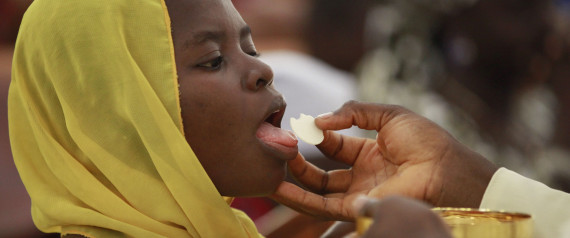
The Catholic doctrine of the Real Presence is the belief that Jesus Christ is literally, not symbolically, present in the Holy Eucharist—body, blood, soul and divinity. Catholics believe in the Real Presence of Christ in the Eucharist because Jesus tells us this is true in the Bible:

“I am the bread of life. Your fathers ate the manna in the wilderness, and they died. This is the bread which comes down from heaven, that a man may eat of it and not die. I am the living bread which came down from heaven; if any one eats of this bread, he will live for ever; and the bread which I shall give for the life of the world is my flesh." The Jews then disputed among themselves, saying, ‘How can this man give us his flesh to eat?’ So Jesus said to them,

"Truly, truly, I say to you, unless you eat the flesh of the Son of man and drink his blood, you have no life in you; he who eats my flesh and drinks my blood has eternal life, and I will raise him up at the last day. For my flesh is food indeed, and my blood is drink indeed. He who eats my flesh and drinks my blood abides in me, and I in him” - John 6:48-56
Furthermore, the early Church Fathers either imply or directly state that the bread and wine offered in the celebration of the Lord’s Supper is really the body and blood of Jesus Christ. In other words, the doctrine of the Real Presence that Catholics believe today was believed by the earliest Christians 2,000 years ago!

This miracle of God’s physical presence to us at every Mass is the truest testament to Christ’s love for us and His desire for each of us to have a personal relationship with Him.

Showing posts with label New Testament. Show all posts

Wednesday, September 25, 2013

THE ORIGINS OF THE EUCHARIST

The Letters of Paul, written between the year 40 and the year 60 speak of the tradition of the celebration of the Eucharist originating in the words and actions of Jesus at his Last Supper which were passed on to him and which he in turn passed on to the communities he established.

The Gospels of Matthew, Mark and Luke recount the meal Jesus shared with his disciples the night before he died in which he associated the actions and words of that meal with his death on the cross on the following day. The Eucharist celebrates and represents this same mystery throughout the ages of the Church. John’s account of the Last Supper has a different emphasis but Chapter 6 of his gospel contains an extended reflection on the meaning of the Bread of Life which is deeply Eucharistic.

The Acts of the Apostles also shows that the Eucharist (at first called ‘the Breaking of Bread’) was one of the cornerstones of Christian life and identity from earliest times. While the first context for the Eucharist was an actual meal, Paul’s Letters show that, even by the mid-first century, the Eucharistic meal was separating from an ordinary meal.

Christianity grew from Jewish roots, and the development of the Eucharist was influenced by Jewish prayer and practice, especially the offering of praise and thanks to God and the liturgical understanding that when the great events of salvation are celebrated ritually, for example at Passover, their power and reality are extended into the present and are immediately available to each person.

The New Testament texts as well as being based in Jesus’ words and actions at the Last Supper were influenced by the words and actions of the first Christian communities as they celebrated the ritual that Jesus gave to his own on the night before his death.

The basic shape of the Eucharist is established in these early texts: bread and wine are taken, thanks and praise are offered to God over them, the bread is broken and the bread and wine received by all. All experience the presence of Christ with them as they eat and drink the Body and Blood of the Lord.

The basic meaning of the Eucharist is also established in the texts of the scripture: the Eucharist proclaims and makes present through the ages the mystery of the Life, Death and Resurrection of Jesus Christ.

FOR REFLECTION AND DISCUSSION

1 How would you describe the connection between Jesus’ words and actions at the Last Supper and his Death on the following day? Why do we say that the Eucharist ‘proclaim[s] the death of the Lord until he comes’ (1Cor 11:26)?

3 Why might Jesus have chosen bread and wine as the way in which he remains present to his church throughout history?

2 Imagine and describe a celebration of the ‘Breaking of the Bread’ before the year 50.

4 ‘The Eucharist makes the Church; the Church makes the Eucharist’ (H. de Lubac). What does this saying tell us about the relationship between the Church and the Eucharist? Could one exist without the other?

Monday, April 16, 2012

THE CATHOLIC RELIGION PROVED BY THE PROTESTANT BIBLE


ANSWERS TO 25 QUESTIONS ON THE
HISTORY OF THE NEW TESTAMENT
WHICH COMPLETELY REFUTE THE "BIBLE ONLY" THEORY

ONE
Did Our Lord write any part of the New Testament or command His Apostles to do so? Our Lord Himself never wrote a line, nor is there any record that He ordered his Apostles to write; He did command them to teach and to preach. Also He to Whom all power was given in Heaven and on earth (Matt. 28-18) promised to give them the Holy Spirit (John 14-26) and to be with them Himself till the end of the world (Mat. 28-20).

COMMENT: If reading the Bible were a necessary means of salvation, Our Lord would have made that statement and also provided the necessary means for his followers.

TWO
How many of the Apostles or others actually wrote what is now in the New Testament? A Few of the Apostles wrote part of Our Lord's teachings, as they themselves expressly stated; i.e., Peter, Paul, James, John, Jude, Matthew, also Sts. Mark and Luke. None of the others wrote anything, so far as is recorded.
COMMENT: If the Bible privately interpreted was to be a Divine rule of Faith, the apostles would have been derelict in their duty when instead, some of them adopted preaching only.
THREE
Was it a teaching or a Bible-reading Church that Christ founded? The Protestant Bible expressly states that Christ founded a teaching Church, which existed before any of the New Testament books were written.

Rom. 10-17: So then faith cometh by HEARING, and hearing by the word of God.


Matt. 28-19: Go ye therefore and TEACH all nations, baptizing them in the name of the Father, and of the Son, and of the Holy Ghost.


Mark. 16-20: And they went forth, and PREACHED everywhere the Lord working with them, and confirming the word with signs following. Amen.


Mark 16-15: And he said unto them, Go ye into all the world and PREACH the gospel to every creature.

COMMENT: Thus falls the entire basis of the "Bible-only" theory.

FOUR
Was there any drastic difference between what Our Lord commanded the Apostles to teach and what the New Testament contains? Our Lord commanded his Apostles to teach all things whatsoever He had commanded; (Matt. 28-20); His Church must necessarily teach everything; (John 14-26); however, the Protestant Bible itself teaches that the Bible does not contain all of Our Lord's doctrines:

John 20-30: And many other signs truly did Jesus in the presence of his disciples, which are not written in this book, etc.


John 21-25: And there are also many other things which Jesus did, the which, if they should be written every one, I suppose that even the world itself could not contain the books that should be written. Amen.

COMMENT: How would it have been possible for second century Christians to practice Our Lord's religion, if private interpretation of an unavailable and only partial account of Christ's teaching were indispensable?

FIVE
Does the New Testament expressly refer to Christ's "unwritten word"? The New Testament itself teaches that it does not contain all that Our Lord did or, consequently, all that He taught.

John 20-30: And many other signs truly did Jesus in the presence of his disciples, which are not written in this book, etc.


John 21-25: And there are also many other things which Jesus did, the which, if they should be written everyone, I suppose that even the world itself could not contain the books that should be written Amen.

COMMENT: Since the Bible is incomplete, it needs something else to supplement it; i.e., the spoken or historically recorded word which we call Tradition.

SIX
What became of the unwritten truths which Our Lord and the Apostles taught? The Church has carefully conserved this "word of mouth" teaching by historical records called Tradition. Even the Protestant Bible teaches that many Christian truths were to be handed down by word of mouth.

2 Thes. 2-15: Therefore, brethren, stand fast, and hold the traditions which ye have been taught, whether by word, or our epistle.


2 Tim. 2-2: And the things that thou hast heard of me among many witnesses, the same commit thou to faithful men, who shall be able to teach others also.

COMMENT: Hence not only Scripture but other sources of information must be consulted to get the whole of Christ's teaching. Religions founded on "the Bible only" are therefore necessarily incomplete.

SEVEN
Between what years were the first and last books of the New Testament written? This first book, St. Matthew's Gospel, was not written until about ten years after Our Lord's Ascension. St. John's fourth gospel and Apocalypse or Book of Revelations were not written until about 100 A. D.

COMMENT: Imagine how the present-day privately interpreted "Bible-only" theory would have appeared at a time when the books of the New Testament were not only unavailable, but most of them had not yet been written.

EIGHT
When was the New Testament placed under one cover? In 397 A. D. by the Council of Carthage, from which it follows that non-Catholics have derived their New Testament from the Catholic Church; no other source was available.

COMMENT: Up to 397 A. D., some of the Christians had access to part of the New Testament; into this situation, how would the "Bible-only privately interpreted" theory have fitted?

NINE
Why so much delay in compiling the New Testament? Prior to 397 A. D., the various books of the New Testament were not under one cover, but were in the custody of different groups or congregations. The persecutions against the Church, which had gained new intensity, prevented these New Testament books from being properly authenticated and placed under one cover. However, this important work was begun after Constantine gave peace to Christianity in 313 A.D., allowing it to be practiced in the Roman Empire.

COMMENT: This again shows how utterly impossible was the "Bible-only" theory, at least up to 400 A. D.

TEN
What other problem confronted those who wished to determine the contents of the New Testament? Before the inspired books were recognized as such, many other books had been written and by many were thought to be inspired; hence the Catholic Church made a thorough examination of the whole question; biblical scholars spent years in the Holy Land studying the original languages of New Testament writings.

more > >

Monday, August 23, 2010

THE CANON OF THE BIBLE

All Christians realize that if God has revealed Himself by communicating His will to man, man must be able to know with assurance where that revelation lies. Hence the need for a list (i.e. canon) of books of the Bible. In other words, man needs to know without error (i.e. infallibly) what the books of the Bible are. There must be an authority which will make that decision.

The canon of the Bible refers to the definitive list of the books which are considered to be divine revelation and included therein. A canon distinguishes what is revealed and divine from what is not revealed and human. "Canon" (Greek kanon) means a reed; a straight rod or bar; a measuring stick; something serving to determine, rule, or measure. Because God did not explicitly reveal what books are the inspired books of the Bible, title by title, to anyone, we must look to His guidance in discovering the canon of the Bible.

Jesus has told us that he has not revealed all truths to us.

John 16:12-13
I have much more to tell you, but you cannot bear it now. But when he comes, the Spirit of truth, he will guide you to all truth.

Jesus then told us how he was planning to assist us in knowing other truths.

John 14:16-17
And I will ask the Father, and he will give you another Advocate to be with you always, the Spirit of truth, which the world cannot accept, because it neither sees nor knows it. But you know it, because it remains with you, and will be in you.

John 15:26
When the Advocate comes whom I will send you from the Father, the Spirit of truth that proceeds from the Father, he will testify to me.

The New Testament writers sensed how they handled truth-bearing under the influence of the Holy Spirit, the Spirit of Truth.

1 Corinthians 15:3-4
For I handed on (paredoka) to you as of first importance what I also received ...

2 Timothy 2:2
And what you heard from me through many witnesses entrust (parathou) to faithful people who will have the ability to teach others as well.

There was a constant history of faithful people from Paul's time through the Apostolic and Post Apostolic Church.

Melito, bishop of Sardis, an ancient city of Asia Minor (see Rev 3), c. 170 AD produced the first known Christian attempt at an Old Testament canon. His list maintains the Septuagint order of books but contains only the Old Testament protocanonicals minus the Book of Esther.

The Council of Laodicea, c. 360, produced a list of books similar to today's canon. This was one of the Church's earliest decisions on a canon. Pope Damasus, 366-384, in his Decree, listed the books of today's canon. The Council of Rome, 382, was the forum which prompted Pope Damasus' Decree. Bishop Exuperius of Toulouse wrote to Pope Innocent I in 405 requesting a list of canonical books. Pope Innocent listed the present canon.

The Council of Hippo, a local north Africa council of bishops created the list of the Old and New Testament books in 393 which is the same as the Roman Catholic list today. The Council of Carthage, a local north Africa council of bishops created the same list of canonical books in 397.

This is the council which many Protestant and Evangelical Christians take as the authority for the New Testament canon of books. The Old Testament canon from the same council is identical to Roman Catholic canon today. Another Council of Carthage in 419 offered the same list of canonical books.

Since the Roman Catholic Church does not define truths unless errors abound on the matter, Roman Catholic Christians look to the Council of Florence, an ecumenical council in 1441 for the first definitive list of canonical books.

The final infallible definition of canonical books for Roman Catholic Christians came from the Council of Trent in 1556 in the face of the errors of the Reformers who rejected seven Old Testament books from the canon of scripture to that time.

There was no canon of scripture in the early Church; there was no Bible. The Bible is the book of the Church; she is not the Church of the Bible. It was the Church--her leadership, faithful people--guided by the authority of the Spirit of Truth which discovered the books inspired by God in their writing. The Church did not create the canon; she discerned the canon. Fixed canons of the Old and New Testaments, hence the Bible, were not known much before the end of the 2nd and early 3rd century.

Catholic Christians together with Protestant and Evangelical Christians hold the same canon of the New Testament, 27 books, all having been originally written in the Greek language.

Catholic Christians accept the longer Old Testament canon, 46 books, from the Greek Septuagint (LXX) translation of the Alexandrian Canon.

Protestant and Evangelical Christians, from the Reformers onward, accept the shorter Old Testament canon, 39 books, from the Hebrew Palestinian Canon. Jews have the same canon as Protestants.

Canonical books are those books which have been acknowledged as belonging to the list of books the Church considers to be inspired and to contain a rule of faith and morals. Some criteria used to determine canonicity were

special relation to God, i.e., inspiration;
apostolic origin;
used in Church services, i.e., used by the community of believers guided by the Holy Spirit.

Other terms for canonical books should be distinguished: the protocanonical books, deuterocanonical books, and the apocryphal books.

The protocanonical (from the Greek proto meaning first) books are those books of the Bible that were admitted into the canon of the Bible with little or no debate (e.g., the Pentateuch of the Old Testament and the Gospels)

The deuterocanonical (from the Greek deutero meaning second) books are those books of the Bible that were under discussion for a while until doubts about their canonicity were resolved (e.g. Sirach and Baruch of the Old Testament, and the Johannine epistles of the New Testament).

The apocryphal (from the Greek apokryphos meaning hidden) books have multiple meanings:

complimentary meaning - that the sacred books were too exalted for the general public;
pejorative meaning - that the orthodoxy of the books were questioned;
heretical meaning - that the books were forbidden to be read; and lastly
neutral meaning - simply noncanonical books, the meaning the word has today.

Another word, pseudepigrapha (from the Greek meaning false writing) is used for works clearly considered to be false.

Sunday, August 22, 2010

THE BIBLE, THE SOLE RULE OF FAITH?


Protestants derive their religion from a mere reading of the Bible which they interpret according to their own private judgment. Catholics derive their doctrines from the Church which propounds to them infallibly the teachings of the Bible and of Tradition.

Which of these two formulas is supported by the Bible itself and by the facts of history, and which consequently is correct?

The Bible makes it clear that Christ established the Church as a teaching organization to speak to the world in His name and with His authority. The Church was to teach men whatsoever He had taught - nothing more and nothing less: "All power is given to Me in heaven and earth. Going therefore, teach ye all nations, baptizing them in the name of the Father, and of the Son, and of the Holy Ghost, teaching them to observe all things whatsoever I have commanded you" (Matthew 28:18-20).

Christ placed on all men the obligation of hearing His Church as they would hear Himself: "He that heareth you, heareth Me" (Luke 10:16); "Go ye into the whole world, and preach the gospel to every creature. He that believeth and is baptized, shall be saved; but he that believeth not shall be condemned" (Mark 16:15-16). He promised to be with the Church and guide it until the end of time: "And behold I am with you all days, even to the consummation of the world" (Matthew 28:20). He sent the Holy Ghost, the Spirit of infallible truth, upon the Apostles and their successors in order that they might be illumined and assisted in the work of continuing the teaching mission of God's own Son.

Our Lord Himself wrote nothing. He commanded the Apostles not to write but to teach and preach: "Going, therefore, teach all nations" and "preach the Gospel to every creature." Christ's disciples and the Christians were commanded to hear the Church, not to read the still nonexistent or at best incomplete New Testament Scriptures: "He who hears you, hears Me."

The teaching Church was in existence long before a single line of the New Testament was written. The Apostles evangelized different peoples, not by presenting to them a copy of the New Testament which did not as yet exist, but by preaching the Gospel, the oral message of Christ to them. Thousands of men became Christians and adhered to the whole truth of God before they saw or read a single book of the New Testament.
It was the leaders of the existing teaching Church who wrote the books of the New Testament. It was the Church which collected and preserved these books, and distinguished them from spurious books which might have otherwise found their way into the Bible. It was from the Catholic church that the Protestants of the sixteenth century took their Bible and also their belief in its divine inspiration.

How illogical, then, it is for a group to step in fifteen hundred years later, wrest the Bible from its historical and lawful possessor and fosterer, put the Bible in the place of the Church, and pretend to possess a true understanding of the purpose and meaning of the Bible?
The different books of the New Testament were for many centuries scattered in the various Christian communities of the Orient. Being written on papyrus which was fragile and breakable, these books could not be widely circulated and hence were read by a comparatively few groups. It was only in 397 A.D. that the Council of Carthage finally decided which books belong to the Bible, and it was about this time, too, that the books of the Bible were combined into one volume. Yet prior to this, the Church spread rapidly to many lands, converts were received into the Church by the thousands, the faith of the people was so strong that it peopled heaven with countless saints and martyrs.

Before the invention of printing in the sixteenth century, copies of the Bible written by hand were so rare and costly that only the rich could procure them. To own a Bible during this period was to own a fortune, and in many instances the Bible had to be chained in order to prevent its being stolen. Were the poor, then, during all these centuries, without a religious guide and teacher?

Was God indifferent to the salvation of the countless souls that passed into eternity during these fifteen hundred years? Did not our Lord provide for the salvation of these unnumbered millions, event though they could not procure, or read, or understand the Bible? We are sure that even our non-Catholic brethren would hardly subscribe to these blasphemous conclusions.

Bible Christianity, then, is an invention of the sixteenth century. In the previous centuries it was not only unknown but it was impossible. Bible Christianity is a formal denial of the Catholic Church, of her divine authority and mission to teach all men. It strives to abrogate the Church which Christ instituted, endeavours to substitute in its place a book, and makes the Bible, as interpreted by one's own private judgment, the sole and supreme rule of faith and morality.

That the Bible is not self-explanatory is apparent, for example, from a mere casual reading of any chapter of the Epistle to the Romans or of the Apocalypse. That it is not self-sufficient is evident from the countless commentaries and books on Sacred Scripture. St. Peter himself was aware of certain difficult passages in the Pauline Epistles when he wrote: "Our most dear brother Paul, according to the wisdom given him, hath written to you, as also in all his epistles speaking in them of these things; in which are certain things hard to be understood, which the unlearned and unstable wrest, as they do also the other Scriptures, to their own destruction" (II Peter 3:15-16).

The Bible is a large and ancient book, and no book can be perfectly intelligible to all man and of all times. It was written at first in the Hebrew and Greek languages which today are understood perfectly by only a few. It reflects the customs, habits of thought and conditions of an ancient civilization and was written in part to meet the problems of those times. It contains supernatural truths which transcend the capacity of human reason. These are only a few reasons why the Bible stands in need of an authoritative explanation.

The Bible is not a textbook or a systematic exposition of Christian doctrine. It does not pretend to be a complete statement of Christian teaching. Three of the Gospels (Matthew, Mark and Luke) are largely three versions of one and the same story. The Pauline Epistles are not doctrinal treatises but letters prompted by the needs of individuals and particularly communities. The thought furthest from the minds of these sacred writers was that their writings should be collected into one volume and considered as a complete statement of Christian theology.

The Bible nowhere states how many of its books are inspired and why. It nowhere teaches the abolition of the Sabbath or the abrogation of the precept prohibiting the eating of blood or things strangled (Acts 15:29). The basic Protestant article that Scripture is the sole rule of faith is not found on its pages. On whose authority, then, do the Protestants accept these doctrines and facts?