Bread of Life

BREAD OF LIFE
 this is the bread that comes down from heaven so that one may eat it and not die. (john 6: 50)
The miracle of God’s physical presence to us at every Mass is the truest testament to Christ’s love for us and His desire for each of us to have a personal relationship with Him. Jesus Christ celebrated the first Mass with His disciples at the Last Supper, the night before He died. He commanded His disciples, “Do this in remembrance of me” (Luke 22:19). The celebration of the Mass then became the main form of worship in the early Church, as a reenactment of the Last Supper, as Christ had commanded. Each and every Mass since commemorates Jesus’ sacrifice on the cross through the Holy Eucharist. Because the Mass “re-presents” (makes present) the sacrifice on Calvary, Catholics all around the world join together to be made present in Christ’s timeless sacrifice for our sins. There is something fascinating about continuing to celebrate the same Mass—instituted by Christ and practiced by the early Church—with the whole community of Catholics around the world…and in heaven.

THE REAL PRESENCE

Why does the Catholic Church believe Christ is really present in the Eucharist?
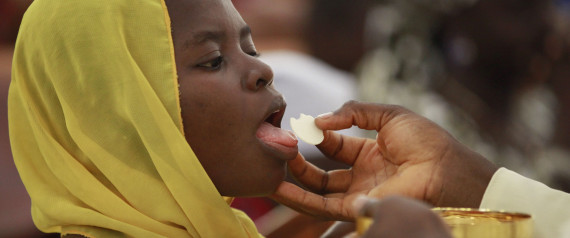
The Catholic doctrine of the Real Presence is the belief that Jesus Christ is literally, not symbolically, present in the Holy Eucharist—body, blood, soul and divinity. Catholics believe in the Real Presence of Christ in the Eucharist because Jesus tells us this is true in the Bible:

“I am the bread of life. Your fathers ate the manna in the wilderness, and they died. This is the bread which comes down from heaven, that a man may eat of it and not die. I am the living bread which came down from heaven; if any one eats of this bread, he will live for ever; and the bread which I shall give for the life of the world is my flesh." The Jews then disputed among themselves, saying, ‘How can this man give us his flesh to eat?’ So Jesus said to them,

"Truly, truly, I say to you, unless you eat the flesh of the Son of man and drink his blood, you have no life in you; he who eats my flesh and drinks my blood has eternal life, and I will raise him up at the last day. For my flesh is food indeed, and my blood is drink indeed. He who eats my flesh and drinks my blood abides in me, and I in him” - John 6:48-56
Furthermore, the early Church Fathers either imply or directly state that the bread and wine offered in the celebration of the Lord’s Supper is really the body and blood of Jesus Christ. In other words, the doctrine of the Real Presence that Catholics believe today was believed by the earliest Christians 2,000 years ago!

This miracle of God’s physical presence to us at every Mass is the truest testament to Christ’s love for us and His desire for each of us to have a personal relationship with Him.

Showing posts with label Old Testament. Show all posts

Sunday, January 26, 2014

THE RESURRECTION OF JESUS; AN ERUPTION OF LIGHT

Homily of Pope Benedict XVI at the Paschal Vigil
The Church Sings the Song of Thanksgiving of the Saved

Dear Brothers and Sisters,

The Mystery of Resurrection

Saint Mark tells us in his Gospel that as the disciples came down from the Mount of the Transfiguration, they were discussing among themselves what "rising from the dead" could mean (cf. Mk 9:10). A little earlier, the Lord had foretold his passion and his resurrection after three days. Peter had protested against this prediction of death. But now, they were wondering what could be meant by the word "resurrection".

Could it be that we find ourselves in a similar situation? Christmas, the birth of the divine Infant, we can somehow immediately comprehend. We can love the child, we can imagine that night in Bethlehem, Mary's joy, the joy of Saint Joseph and the shepherds, the exultation of the angels.

But what is resurrection? It does not form part of our experience, and so the message often remains to some degree beyond our understanding, a thing of the past. The Church tries to help us understand it, by expressing this mysterious event in the language of symbols in which we can somehow contemplate this astonishing event. During the Easter Vigil, the Church points out the significance of this day principally through three symbols: light, water, and the new song - the Alleluia.

Light

First of all, there is light. God's creation - which has just been proclaimed to us in the Biblical narrative - begins with the command: "Let there be light!" (Gen 1:3). Where there is light, life is born, chaos can be transformed into cosmos. In the Biblical message, light is the most immediate image of God: He is total Radiance, Life, Truth, Light. During the Easter Vigil, the Church reads the account of creation as a prophecy. In the resurrection, we see the most sublime fulfilment of what this text describes as the beginning of all things.

God says once again: "Let there be light!" The resurrection of Jesus is an eruption of light. Death is conquered, the tomb is thrown open. The Risen One himself is Light, the Light of the world. With the resurrection, the Lord's day enters the nights of history. Beginning with the resurrection, God's light spreads throughout the world and throughout history.

Day dawns. This Light alone - Jesus Christ - is the true light, something more than the physical phenomenon of light. He is pure Light: God himself, who causes a new creation to be born in the midst of the old, transforming chaos into cosmos.

Lumen Christi

Let us try to understand this a little better. Why is Christ Light? In the Old Testament, the Torah was considered to be like the light coming from God for the world and for humanity. The Torah separates light from darkness within creation, that is to say, good from evil. It points out to humanity the right path to true life.

It points out the good, it demonstrates the truth and it leads us towards love, which is the deepest meaning contained in the Torah. It is a "lamp" for our steps and a "light" for our path (cf. Ps 119:105). Christians, then, knew that in Christ, the Torah is present, the Word of God is present in him as Person. The Word of God is the true light that humanity needs. This Word is present in him, in the Son.

Psalm 19 had compared the Torah to the sun which manifests God's glory as it rises, for all the world to see. Christians understand: yes indeed, in the resurrection, the Son of God has emerged as the Light of the world. Christ is the great Light from which all life originates.

He enables us to recognize the glory of God from one end of the earth to the other. He points out our path. He is the Lord's day which, as it grows, is gradually spreading throughout the earth. Now, living with him and for him, we can live in the light.

Fire

At the Easter Vigil, the Church represents the mystery of the light of Christ in the sign of the Paschal candle, whose flame is both light and heat. The symbolism of light is connected with that of fire: radiance and heat, radiance and the transforming energy contained in the fire - truth and love go together. The Paschal candle burns, and is thereby consumed: Cross and resurrection are inseparable.

From the Cross, from the Son's self-giving, light is born, true radiance comes into the world. From the Paschal candle we all light our own candles, especially the newly baptized, for whom the light of Christ enters deeply into their hearts in this Sacrament. The early Church described Baptism as fotismos, as the Sacrament of illumination, as a communication of light, and linked it inseparably with the resurrection of Christ.

In Baptism, God says to the candidate: "Let there be light!" The candidate is brought into the light of Christ. Christ now divides the light from the darkness. In him we recognize what is true and what is false, what is radiance and what is darkness. With him, there wells up within us the light of truth, and we begin to understand.

On one occasion when Christ looked upon the people who had come to listen to him, seeking some guidance from him, he felt compassion for them, because they were like sheep without a shepherd (cf. Mk 6:34). Amid the contradictory messages of that time, they did not know which way to turn.

What great compassion he must feel in our own time too - on account of all the endless talk that people hide behind, while in reality they are totally confused. Where must we go? What are the values by which we can order our lives? The values by which we can educate our young, without giving them norms they may be unable to resist, or demanding of them things that perhaps should not be imposed upon them? He is the Light.

The baptismal candle is the symbol of enlightenment that is given to us in Baptism. Thus at this hour, Saint Paul speaks to us with great immediacy. In the Letter to the Philippians, he says that, in the midst of a crooked and perverse generation, Christians should shine as lights in the world (cf. Phil 2:15). Let us pray to the Lord that the fragile flame of the candle he has lit in us, the delicate light of his word and his love amid the confusions of this age, will not be extinguished in us, but will become ever stronger and brighter, so that we, with him, can be people of the day, bright stars lighting up our time.

Water

The second symbol of the Easter Vigil - the night of Baptism - is water. It appears in Sacred Scripture, and hence also in the inner structure of the Sacrament of Baptism, with two opposed meanings. On the one hand there is the sea, which appears as a force antagonistic to life on earth, continually threatening it; yet God has placed a limit upon it.

Hence the book of Revelation says that in God's new world, the sea will be no more (cf. 21:1). It is the element of death. And so it becomes the symbolic representation of Jesus' death on the Cross: Christ descended into the sea, into the waters of death, as Israel did into the Red Sea. Having risen from death, he gives us life. This means that Baptism is not only a cleansing, but a new birth: with Christ we, as it were, descend into the sea of death, so as to rise up again as new creatures.

The other way in which we encounter water is in the form of the fresh spring that gives life, or the great river from which life comes forth. According to the earliest practice of the Church, Baptism had to be administered with water from a fresh spring. Without water there is no life. It is striking how much importance is attached to wells in Sacred Scripture. They are places from which life rises forth.

Beside Jacob's well, Christ spoke to the Samaritan woman of the new well, the water of true life. He reveals himself to her as the new, definitive Jacob, who opens up for humanity the well that is awaited: the inexhaustible source of life-giving water (cf. Jn 4:5-15). Saint John tells us that a soldier with a lance struck the side of Jesus, and from his open side - from his pierced heart - there came out blood and water (cf. Jn 19:34).

The early Church saw in this a symbol of Baptism and Eucharist flowing from the pierced heart of Jesus. In his death, Jesus himself became the spring. The prophet Ezekiel saw a vision of the new Temple from which a spring issues forth that becomes a great life-giving river (cf. Ezek 47:1-12).

In a land which constantly suffered from drought and water shortage, this was a great vision of hope. Nascent Christianity understood: in Christ, this vision was fulfilled. He is the true, living Temple of God. He is the spring of living water. From him, the great river pours forth, which in Baptism renews the world and makes it fruitful; the great river of living water, his Gospel which makes the earth fertile.

In a discourse during the Feast of Tabernacles, though, Jesus prophesied something still greater: "Whoever believes in me out of his heart shall flow rivers of living water" (Jn 7:38). In Baptism, the Lord makes us not only persons of light, but also sources from which living water bursts forth. We all know people like that, who leave us somehow refreshed and renewed; people who are like a fountain of fresh spring water.

We do not necessarily have to think of great saints like Augustine, Francis of Assisi, Teresa of Avila, Mother Teresa of Calcutta and so on, people through whom rivers of living water truly entered into human history. Thanks be to God, we find them constantly even in our daily lives: people who are like a spring. Certainly, we also know the opposite: people who spread around themselves an atmosphere like a stagnant pool of stale, or even poisoned water. Let us ask the Lord, who has given us the grace of Baptism, for the gift always to be sources of pure, fresh water, bubbling up from the fountain of his truth and his love!

The Alleluia

The third great symbol of the Easter Vigil is something rather different; it has to do with man himself. It is the singing of the new song - the alleluia. When a person experiences great joy, he cannot keep it to himself. He has to express it, to pass it on. But what happens when a person is touched by the light of the resurrection, and thus comes into contact with Life itself, with Truth and Love? He cannot merely speak about it. Speech is no longer adequate. He has to sing.

The first reference to singing in the Bible comes after the crossing of the Red Sea. Israel has risen out of slavery. It has climbed up from the threatening depths of the sea. It is as it were reborn. It lives and it is free. The Bible describes the people's reaction to this great event of salvation with the verse: "The people believed in the Lord and in Moses his servant" (Ex 14:31).

Then comes the second reaction which, with a kind of inner necessity, follows from the first one: "Then Moses and the Israelites sang this song to the Lord " At the Easter Vigil, year after year, we Christians intone this song after the third reading, we sing it as our song, because we too, through God's power, have been drawn forth from the water and liberated for true life.

There is a surprising parallel to the story of Moses' song after Israel's liberation from Egypt upon emerging from the Red Sea, namely in the Book of Revelation of Saint John. Before the beginning of the seven last plagues imposed upon the earth, the seer has a vision of something "like a sea of glass mingled with fire; and those who had conquered the beast and its image and the number of its name, standing beside the sea of glass with harps of God in their hands.

And they sing the song of Moses, the servant of God, and the song of the Lamb " (Rev 15:2f.). This image describes the situation of the disciples of Jesus Christ in every age, the situation of the Church in the history of this world. Humanly speaking, it is self-contradictory. On the one hand, the community is located at the Exodus, in the midst of the Red Sea, in a sea which is paradoxically ice and fire at the same time. And must not the Church, so to speak, always walk on the sea, through the fire and the cold? Humanly speaking, she ought to sink.

But while she is still walking in the midst of this Red Sea, she sings - she intones the song of praise of the just: the song of Moses and of the Lamb, in which the Old and New Covenants blend into harmony. While, strictly speaking, she ought to be sinking, the Church sings the song of thanksgiving of the saved. She is standing on history's waters of death and yet she has already risen. Singing, she grasps at the Lord's hand, which holds her above the waters.

And she knows that she is thereby raised outside the force of gravity of death and evil - a force from which otherwise there would be no way of escape - raised and drawn into the new gravitational force of God, of truth and of love. At present she is still between the two gravitational fields.

But once Christ is risen, the gravitational pull of love is stronger than that of hatred; the force of gravity of life is stronger than that of death. Perhaps this is actually the situation of the Church in every age? It always seems as if she ought to be sinking, and yet she is always already saved.

Saint Paul illustrated this situation with the words: "We are as dying, and behold we live" (2 Cor 6:9). The Lord's saving hand holds us up, and thus we can already sing the song of the saved, the new song of the risen ones: alleluia! Amen.

Saturday, July 30, 2011

EATING CHRIST'S FLESH AND DRINKING HIS BLOOD PART 1

A Study by Dr. Andrew M. Fountain

John 6:51-58: "I am the living bread which came down from heaven. If anyone eats of this bread, he will live forever; and the bread that I shall give is My flesh, which I shall give for the life of the world." 52 The Jews therefore quarreled among themselves, saying, "How can this Man give us His flesh to eat?" 53 Then Jesus said to them, "Most assuredly, I say to you, unless you eat the flesh of the Son of Man and drink His blood, you have no life in you. 54 "Whoever eats My flesh and drinks My blood has eternal life, and I will raise him up at the last day. 55 "For My flesh is food indeed, and My blood is drink indeed. 56 "He who eats My flesh and drinks My blood abides in Me, and I in him. 57 "As the living Father sent Me, and I live because of the Father, so he who feeds on Me will live because of Me. 58 "This is the bread which came down from heaven; not as your fathers ate the manna, and are dead. He who eats this bread will live forever."

You might think that this is a rather odd subject to write about. I agree that it is a very strange image, but it is an image Christ gave. He spoke most unapologetically, even though most of the people to whom He was speaking clearly did not understand Him and found it somewhat offensive. Today we would think it bizarre if someone spoke to us about eating their flesh and drinking their blood. What does it mean? How are we to understand it?

The passage might make us think of the Lord’s Supper, the Breaking of Bread, but there is only an indirect connection. When we Break Bread, we remember Christ by eating the bread and drinking the wine which symbolizes His body and His blood. But there is no reference in this passage to the bread or the wine. There is a kind of connection with the Lord’s Supper because they are both pointing to the same event, Christ’s death, but Jesus is not referring here to the ordinance of the Lord’s Supper. He is talking about something else, even though the picture is similar.

1. The Meaning of the Image
The first question we have to ask is what does Jesus actually mean here by eating His flesh and drinking His blood. Obviously, he is not talking about cannibalism, about physically eating somebody’s flesh and actually drinking their blood. Clearly that idea is not here at all, so what is it He is referring to? Why does He use this picture?

Light from the Old Testament
The word blood is used frequently in the Bible to mean violent death. For example, 2 Sam 3:28 "Afterward, when David heard it, he said, "My kingdom and I are guiltless before the LORD forever of the blood of Abner the son of Ner." and Psalm 30:9: "What profit is there in my blood, when I go down to the pit? will the dust praise You?" There are many places where we read of someone having a man's blood on their head. It means they are guilty of the death of that man. When the Bible refers to blood being poured out or being spilt, or blood anytime outside of the body, it is usually a graphic metaphor for violent death.

We have two very interesting Old Testament references which help us to understand what Jesus is talking about. The first is in Psalm 27:2 where David is talking about the wicked who are coming against him. "When the wicked came against me to eat up my flesh, my enemies and foes, they stumbled and fell." We have to ask ourselves, does David literally mean that these are cannibalistic enemies or is he using picture language? He is talking here about the wicked who want to profit from his death. They want to kill David because they want to obtain some kind of benefit from his death. This example from the Old Testament gives us an insight into what Jesus means by eating his flesh—it means to benefit from His death on the cross.

Interestingly enough, there is an occasion in David’s life where he also uses the image of drinking blood. When he was on the run from Saul he gathered a group of mighty men around him. At one point he was fighting the Philistines who had taken the town of Bethlehem and he remarked how much he would love a drink from the well of Bethlehem. Three of his mighty men heard this and took him seriously. They fought their way through the Philistine line, got water from Bethlehem and brought it back to David. In 1 Chronicles 11:19 David says, "Far be it from me, O my God, that I should do this! Shall I drink the blood of these men who have put their lives in jeopardy? For at the risk of their lives they brought it." He says that to drink this water would be like drinking the blood of these men, not literally their blood, but it would be like profiting from their near death, since they risked their lives for him. You could say, enjoying the benefits which came at the expense of their lives.

That phrase really sums up what Jesus is talking about here. When He refers to eating His flesh and drinking His blood, He is talking about enjoying the benefits which come from His death.

Our Food and Drink
Perhaps the most powerful image that these words have is simply that of the food and drink that sustains our lives. Food is something we all need moment by moment to sustain us. We cannot go long without a drink because liquid is vital for our bodies. Jesus is teaching us that we need to depend on Him utterly, moment by moment, in order to survive.

There is another place in John’s Gospel where Jesus uses an image to demonstrate how the believer is sustained moment by moment from Himself. It is the image of the vine and the branches. A branch, cut away from the vine, is cut away from the sap—that source of nourishment and fluid flowing up—and would die straight away. We must be joined to Christ and constantly feeding from Him and drawing sustenance from Him in order to be sustained.

That is the idea behind this passage, but we must ask how are we to apply it to ourselves?

2. What it Means in Practice
How do we practically feed on Christ’s flesh and drink His blood? I am going to try and build up a picture by comparing Jesus' words in different places here in John 6.

A. This eating and drinking results in everlasting life
6:27 "Do not labor for the food which perishes, but for the food which endures to everlasting life, which the Son of Man will give you"

6:50-51a "This is the bread which comes down from heaven, that one may eat of it and not die. I am the living bread which came down from heaven. If anyone eats of this bread, he will live forever"

6:53 "unless you eat the flesh of the Son of Man and drink His blood, you have no life in you."

6:54 "Whoever eats My flesh and drinks My blood has eternal life, and I will raise him up at the last day."

We can also think of the woman of Samaria who was told in John 4:14 that drinking the water that Christ offers would lead to everlasting life.

Eating and drinking > > everlasting life
So we can say very definitely that eating and drinking results in everlasting life. But is there anything else that Jesus says leads to everlasting life? If there are other things, then they will help us understand what it means to eat His flesh and drink His blood.

B. Believing also leads to everlasting life
3:16 "...that whoever believes in Him should not perish but have everlasting life"
6:40 "...that everyone who sees the Son and believes in Him may have everlasting life; and I will raise him up at the last day."

6:47 "Most assuredly, I say to you, he who believes in Me has everlasting life."

There are many other places in the New Testament where similar things are said.

Believing > > everlasting life
So, believing in Christ and eating His flesh and drinking His blood are both things that lead to everlasting life. We can put them together. Whatever He means by eating and drinking, it is the same kind of thing as believing because both of them lead to everlasting life.

C. Coming to Jesus has a similar meaning
6:35 "I am the bread of life. He who comes to Me shall never hunger, and he who believes in Me shall never thirst." [coming and believing are put in parallel]

5:40 "But you are not willing to come to Me that you may have life."

7:37 "If anyone thirsts, let him come to Me and drink. He who believes in Me, as the Scripture has said, out of his heart will flow rivers of living water."

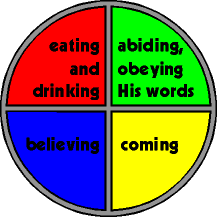
Eating and drinking, Believing, Coming > > everlasting life
I am trying to build up a picture here of the images that are used to mean the same thing as eating and drinking. Here, believing and coming are used in a parallel fashion. Their meanings are not identical, but the comparison sheds light on how we should understand each individual image.

D. Obeying/Abiding in the words of Christ
There is one other image, that of obeying Christ’s words and abiding in them.
15:10 "If you keep My commandments, you will abide in My love, just as I have kept My Father's commandments and abide in His love." [This is a very important verse because it explains what it means to abide in Christ]

6:56 "He who eats My flesh and drinks My blood abides in Me, and I in him."

Abiding in Christ = keeping His commandments

Abiding in Christ = Eating and drinking
Looking at these references allows us to build up an image of what Jesus is talking about. Here, quite clearly, eating His flesh and drinking His blood is equivalent to abiding in Him, which we learned from chapter 15 is obeying His words.


There are four ideas that are linked together here. We will see in part 2 how these work out in the life of a Christian.

But why does Jesus use such unusual language and powerful images? The hearers needed to have their thinking totally reversed. Have you ever been in a situation where you have fairly settled thoughts and opinions about something that are turned utterly upside down by a new discovery?

I once read a story, recounted by Frank Koch, in Proceedings, (the magazine of the Naval Institute).

Two battleships assigned to the training squadron had been at sea on manoeuvers in heavy weather for several days. I was serving on the lead battleship and was on watch on the bridge as night fell. The visibility was poor with patchy fog, so the captain remained on the bridge keeping an eye on all activities.

Shortly after dark, the lookout on the wing of the bridge reported, "Light, bearing on the starboard bow."

"Is it steady or moving astern?" the captain called out.

Lookout replied, "Steady, captain," which meant we were on a dangerous collision course with that ship.

The captain then called to the signalman, "Signal that ship: we are on a collision course, advise you change course 20 degrees."

Back came a signal, "Advisable for you to change course 20 degrees."

The captain said, "Send, I'm a captain, change course 20 degrees."

"I'm a seaman second class," came the reply. "You had better change course 20 degrees."

By that time, the captain was furious. He spat out, "Send, I'm a battleship. Change course 20 degrees."

Back came the flashing light, "I'm a lighthouse."

We changed course.

Christ intends us to radically change course in our lives. We will begin part 2 by looking at a verse that seems to me to be the Christ-centred key for opening up our understanding of the passage. This verse, which at first sight appears rather difficult, is John 6:57 "As the living Father sent Me, and I live because of the Father, so he who feeds on Me will live because of Me." We will see that in some ways, Christ's relationship with the Father gives us amazing insights into how we should live.

Part 2 >

Monday, August 23, 2010

THE CANON OF THE BIBLE

All Christians realize that if God has revealed Himself by communicating His will to man, man must be able to know with assurance where that revelation lies. Hence the need for a list (i.e. canon) of books of the Bible. In other words, man needs to know without error (i.e. infallibly) what the books of the Bible are. There must be an authority which will make that decision.

The canon of the Bible refers to the definitive list of the books which are considered to be divine revelation and included therein. A canon distinguishes what is revealed and divine from what is not revealed and human. "Canon" (Greek kanon) means a reed; a straight rod or bar; a measuring stick; something serving to determine, rule, or measure. Because God did not explicitly reveal what books are the inspired books of the Bible, title by title, to anyone, we must look to His guidance in discovering the canon of the Bible.

Jesus has told us that he has not revealed all truths to us.

John 16:12-13
I have much more to tell you, but you cannot bear it now. But when he comes, the Spirit of truth, he will guide you to all truth.

Jesus then told us how he was planning to assist us in knowing other truths.

John 14:16-17
And I will ask the Father, and he will give you another Advocate to be with you always, the Spirit of truth, which the world cannot accept, because it neither sees nor knows it. But you know it, because it remains with you, and will be in you.

John 15:26
When the Advocate comes whom I will send you from the Father, the Spirit of truth that proceeds from the Father, he will testify to me.

The New Testament writers sensed how they handled truth-bearing under the influence of the Holy Spirit, the Spirit of Truth.

1 Corinthians 15:3-4
For I handed on (paredoka) to you as of first importance what I also received ...

2 Timothy 2:2
And what you heard from me through many witnesses entrust (parathou) to faithful people who will have the ability to teach others as well.

There was a constant history of faithful people from Paul's time through the Apostolic and Post Apostolic Church.

Melito, bishop of Sardis, an ancient city of Asia Minor (see Rev 3), c. 170 AD produced the first known Christian attempt at an Old Testament canon. His list maintains the Septuagint order of books but contains only the Old Testament protocanonicals minus the Book of Esther.

The Council of Laodicea, c. 360, produced a list of books similar to today's canon. This was one of the Church's earliest decisions on a canon. Pope Damasus, 366-384, in his Decree, listed the books of today's canon. The Council of Rome, 382, was the forum which prompted Pope Damasus' Decree. Bishop Exuperius of Toulouse wrote to Pope Innocent I in 405 requesting a list of canonical books. Pope Innocent listed the present canon.

The Council of Hippo, a local north Africa council of bishops created the list of the Old and New Testament books in 393 which is the same as the Roman Catholic list today. The Council of Carthage, a local north Africa council of bishops created the same list of canonical books in 397.

This is the council which many Protestant and Evangelical Christians take as the authority for the New Testament canon of books. The Old Testament canon from the same council is identical to Roman Catholic canon today. Another Council of Carthage in 419 offered the same list of canonical books.

Since the Roman Catholic Church does not define truths unless errors abound on the matter, Roman Catholic Christians look to the Council of Florence, an ecumenical council in 1441 for the first definitive list of canonical books.

The final infallible definition of canonical books for Roman Catholic Christians came from the Council of Trent in 1556 in the face of the errors of the Reformers who rejected seven Old Testament books from the canon of scripture to that time.

There was no canon of scripture in the early Church; there was no Bible. The Bible is the book of the Church; she is not the Church of the Bible. It was the Church--her leadership, faithful people--guided by the authority of the Spirit of Truth which discovered the books inspired by God in their writing. The Church did not create the canon; she discerned the canon. Fixed canons of the Old and New Testaments, hence the Bible, were not known much before the end of the 2nd and early 3rd century.

Catholic Christians together with Protestant and Evangelical Christians hold the same canon of the New Testament, 27 books, all having been originally written in the Greek language.

Catholic Christians accept the longer Old Testament canon, 46 books, from the Greek Septuagint (LXX) translation of the Alexandrian Canon.

Protestant and Evangelical Christians, from the Reformers onward, accept the shorter Old Testament canon, 39 books, from the Hebrew Palestinian Canon. Jews have the same canon as Protestants.

Canonical books are those books which have been acknowledged as belonging to the list of books the Church considers to be inspired and to contain a rule of faith and morals. Some criteria used to determine canonicity were

special relation to God, i.e., inspiration;
apostolic origin;
used in Church services, i.e., used by the community of believers guided by the Holy Spirit.

Other terms for canonical books should be distinguished: the protocanonical books, deuterocanonical books, and the apocryphal books.

The protocanonical (from the Greek proto meaning first) books are those books of the Bible that were admitted into the canon of the Bible with little or no debate (e.g., the Pentateuch of the Old Testament and the Gospels)

The deuterocanonical (from the Greek deutero meaning second) books are those books of the Bible that were under discussion for a while until doubts about their canonicity were resolved (e.g. Sirach and Baruch of the Old Testament, and the Johannine epistles of the New Testament).

The apocryphal (from the Greek apokryphos meaning hidden) books have multiple meanings:

complimentary meaning - that the sacred books were too exalted for the general public;
pejorative meaning - that the orthodoxy of the books were questioned;
heretical meaning - that the books were forbidden to be read; and lastly
neutral meaning - simply noncanonical books, the meaning the word has today.

Another word, pseudepigrapha (from the Greek meaning false writing) is used for works clearly considered to be false.