


The Missing Cup
To fully understand the Last Supper, we must first understand the four-fold structure of the Jewish Passover. It is worth quoting in full a passage from Catholic for a Reason 3:
The first movement began with a festal blessing of the day and the passing around of the first cup of wine (the qiddush cup). This was followed by a preliminary course of green herbs, bitter herbs, and haroset. The second movement included the retelling of the Passover story, the singing of the first Hallel hymn—either Psalm 113 or Psalms 113 and 114 together—and the drinking of the second cup (the haggadah cup). The third movement was the heart of the celebration—the main meal. It began with the blessing of unleavened bread and continued with a feast of lamb, unleavened bread, and more bitter herbs. After dinner, participants shared the third cup of wine (the berakah cup). The fourth movement ended the festivities with the chanting of the final Hallel Psalm and a blessing over the final cup (the hallel cup).1
With this in mind, we can place the Last Supper narratives within the context of the Passover meal. Luke places the consecration of the wine “after supper” (Luke 22:20), the third movement, after which Jesus and the apostles sing the final Hallel Psalm (Matthew 26:30, Mark 14:26). Thus, the only thing left to do was to share the final cup, which they did right before they left, right? Wrong. Scripture tells us that “[w]hen they had sung the [final Hallel] hymn, they went out to the Mount of Olives” (Matthew 26:30). So where did the fourth cup go?
The Lamb of God
To answer this question, we must read the previous verse, in which Jesus says, “I tell you, I will never again drink of this fruit of the vine until that day when I drink it new with you in my Father’s kingdom” (Matthew 26:29). Protestants often use this verse to argue against the Catholic belief in the Real Presence, claiming that by calling the Eucharistic cup “fruit of the vine,” Jesus indicated that it was still wine. However, this is based on a cursory reading of the text in isolation, but a deeper reading of what Scripture says about the Last Supper and Jesus’ sacrifice reveals a much more profound meaning.
In Gethsemane, Jesus prays, “My Father, if it is possible, let this cup pass from me” (Matthew 26:39). He refers to His upcoming suffering as a cup, possibly referring to the cup of God’s wrath (Isaiah 51:17, Jeremiah 25:15). However, I believe that there is also a deeper meaning; this has something to do with the wine that Jesus will drink “that day when I drink it new with you in my Father’s kingdom.”
In Mark 15:23, Roman soldiers offer Jesus “wine mixed with myrrh,” but He refuses, presumably because it is not yet “that day.” Then, in Mark 15:36, “someone ran, filled a sponge with sour wine, put it on a stick, and gave it to him [Jesus] to drink,” but we are not told if He accepted it or not. Since it was not yet “that day,” we can assume that He refused, right? No. In John 21:29-30 we read, “A jar full of sour wine was standing there. So they put a sponge full of the wine on a branch of hyssop and held it to his mouth. When Jesus had received the wine, he said, ‘It is finished.’” He was not yet in the Father’s kingdom, so why did He drink the wine?
It was the fourth cup. Jesus, the “Lamb of God who takes away the sin of the world” (John 1:19), replaced the traditional Passover lamb (which was strangely absent from all of the Last Supper narratives) and became “our Paschal Lamb… [who] has been sacrificed” (1 Corinthians 5:7). At the Last Supper, He purposely left out the fourth cup to extend the meal into the next day. At Gethsemane, He asked God to take away His responsibility to complete the Passover meal with His death and drink the fourth cup. When He referred to the consecrated wine as “fruit of the vine,” He was not implying that it was only mere wine; rather, He meant to establish the continuity between the first three cups of Passover wine (the third of which He turned into His blood) and the fourth cup, which He drank on the cross. Not only was Jesus’ sacrifice the fulfillment of the Jewish Passover, but it was actually part of the Passover.
The Mass and the Eucharist
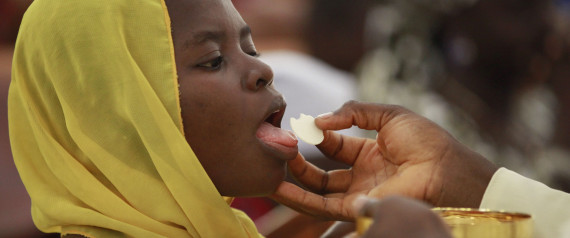
When God instituted the Passover in Egypt, the Israelites had to eat the lamb and burn what was left; they were not to let any part of it remain (Exodus 12:8-10). Similarly, in the Eucharist, the new Passover, we must also eat the Lamb, Jesus. It was not enough for the Israelites to eat lamb-shaped wafers that symbolized the lamb, and it is not enough for us to eat wafers that symbolize Jesus. No, like the Israelites, we are to eat the Passover Lamb, just as Jesus commanded us when, during the phase in which the lamb was normally eaten, He took bread and wine and turned them into His body and blood.
When Jesus said, “Do this in remembrance of me” (Luke 22:19), the Greek word for remembrance is anamnesis, which refers to not to a mere memorial but to a memorial sacrifice, as can be seen by the Septuagint’s usage of it in Leviticus 24:7 and Numbers 10:9-10.2 Because we know that Jesus was the Passover Lamb, we can better understand this command. He was not instituting some vague, nebulous sacrifice outside of any meaningful context; rather, he instituted the Eucharistic sacrifice at the moment when He told the apostles to eat the flesh and drink the blood of the new Passover Lamb. He was instituting the sacrifice of the Mass, the new Passover, in which we continually re-offer Jesus’ Paschal sacrifice to the Father and partake of His body and blood.
When Jesus consecrated the third cup, He said that He would not drink the fourth cup until “the kingdom of God comes” (Luke 22:18), which, knowing what He was referring to, may seem a bit strange. However, if we meditate on what Jesus accomplished on the cross, His meaning becomes clear: by reconciling us to the Father, Jesus ushered in the kingdom of God.3 This is simple enough, but the Gospels of Matthew and Mark add two other elements: Jesus will drink the wine new in the kingdom of God, and He will drink it with His apostles. It’s easy to see how He will drink it new because it marked the end of His sacrifice, the new Passover, but how will He drink it with the apostles? They were not all present at the cross, so what did He mean?
To properly understand His words, we must understand the Mass, in which God, who transcends time, makes Jesus’ past sacrifice present to us then and there, and we re-offer it up to the Father through the priest, who acts in the person of Christ.4 When we celebrate Mass, we actually participate in the heavenly liturgy that John saw in the book of Revelation.5 In Revelation, John sees Jesus as “a Lamb, standing as if it had been slaughtered” (Revelation 5:6), symbolizing His continuous offering of Himself to the Father. With this in mind, we can properly interpret Jesus’ words about the fourth cup. Not only did He drink the fourth cup as he was completing the new Passover and ushering in the kingdom of God, but He also continually offers that same Paschal sacrifice to the Father in heaven as we participate in the heavenly liturgy. Jesus drinks the fourth cup and offers His sacrifice to the Father with the apostles, angels, saints, and us every time Mass is celebrated.
Conclusion
With the proper understanding of what the Last Supper actually was, Jesus’ words fall into place. We can see why He “eagerly desired to eat this Passover” with the apostles (Luke 22:15) and why He commanded us to eat His flesh and drink His blood. Nevertheless, this is only the beginning. For a full understanding of Scripture’s teachings on the Mass and the Eucharist, we must study Old Testament prophecies, Jesus’ words outside the Last Supper, and the apostles’ understanding of the Eucharistic sacrifice. I hope that I have at least given you a firm foundation in the Bible’s teaching on this subject, on which you can build a comprehensive understanding of all of Scripture’s Eucharistic teachings.
Endnotes
1) Curtis J. Mitch, “The Mass and the Synoptic Gospels” in Catholic for a Reason 3: Scripture and the Mystery of the Mass, ed. Scott Hahn and Leon Suprenant, Jr.
2) Robert Sungenis, Not by Bread Alone
3) Catechism of the Catholic Church 542, 766
4) ibid. 1348, 1367-1367; cf. Hebrews 7:24-25
5) Sacrosanctum Concilium 8; Catechism of the Catholic Church 1137. For a better understanding of this, see The Lamb’s Supper by Scott Hahn and “The Mass and the Apocalypse” by Michael Barber in Catholic for a Reason 3.


